Showing posts with label UK. Show all posts

Tuesday, 12 September 2017

High above the High Street


There is a place that feels like it should not exist. Well, OK, I suppose there are many places that feel like they should not exit, but the one I am thinking of is the Roof Gardens high above Kensington High Street. I had been there several years before, for a work dinner, and at the time had been astonished by the place. A few months ago, whilst visiting the new Design Museum in Kensington, I decided to pay it another visit, and was not disappointed. To enter this strange world, you have to present yourself at a reception desk behind a door up a side street, and provide some ID. By and large, you don't have to book, and entrance is free. After signing in, you are pointed towards a lift lined with pictures of flamingos, and are sent to the top of the building.

When you emerge, you are in a somewhat anonymous corridor, but after wandering around a little, you emerge into the daylight where you may find yourself, miraculously, in a Spanish garden, a medieval courtyard, or an English woodland. All six stories up, beside a busy London thoroughfare. The unreality of the place brings to mind the original film Westworld, and from certain angles, you could easily be forgiven for believing you were in Grenada, or the grounds of a well-preserved Tudor mansion. Only the spire of St Mary Abbots church peeking out over the moorish colonnade, perhaps, gives the game away.

The gardens opened to the public in May 1938, having been built over the course of two. The original idea came from Trevor Bowen, the vice president of John Barker & Co., the original owners of the building on which the gardens sit. He hired the landscape architect Ralph Hancock to turn his idea into reality, which Hancock did to incredible effect. Appropriately enough, although they take a little finding, being hidden away in one corder of the woodland garden beside a quirky 1930s house, there are plaques to both gentlemen, commemorating their work.

The garden is not just an oasis of calm in a busy city, although it assuredly is this; it is also a miniature wildlife garden. Walking from the Tudor garden to the woodland, past natural-looking ponds (six floors up, remember) you are likely to come face to beak with the flamingos pictured in the lift, along with a variety of exotic ducks. On a bright, quiet, weekday morning, I walked around this delightful folly, which I had largely to myself, and felt like I had travelled to another world.

Friday, 28 April 2017

Concen-Tate


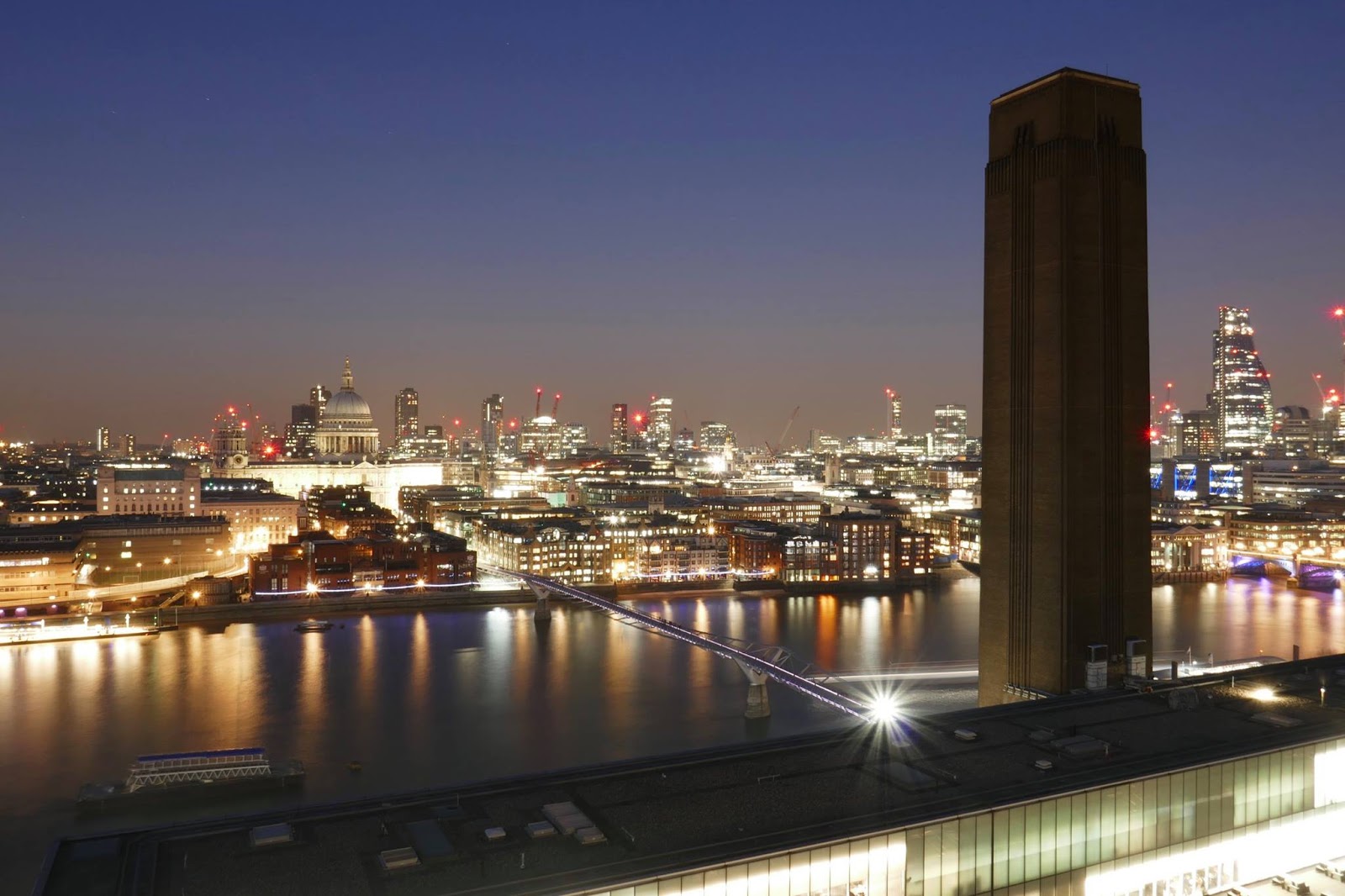
Many years ago, I watched as an abandoned power station in the middle of London was transformed into the Tate Modern, a shiny new gallery of contemporary art. For several consecutive summers towards the end of the 1990s, I was working practically next door, and year by year I could see the immense changes that were taking place both within and outside the enormous old brick building, as it transitioned from one use to another. At the time, it was the most obvious, but by no means the first, act of regeneration along the Southbank, and on this stretch of Bankside in general. The original building, constructed in two stages between 1947 and 1963, was designed by Sir Giles Gilbert Scott, famously the architect of several other British design icons, such as the red phone box and the Battersea Power Station, and its revamp was designed by Herzog & de Meuron.

There used to be enormous earth bunds between the building and the river, which in the summer served as miniature amphitheatres, in which outdoor Shakespeare performances were held. These earthworks were eventually removed, to make way for grass lawns, which inevitably could not stand up to the enormous use of the gallery visitors, quickly becoming scrubby mud patches. The Tate Modern development followed the opening of Shakespeare's Globe and, at around the same time, the Millennium Bridge across the Thames was constructed. The Tate Modern opened on 11 May 2000, the old chimney initially topped with a light-box, which changed colour.

The Millennium  Bridge opened on 10 June 2000, but closed again for modifications on 12 June 2000, owing to its now infamous "wobbliness", caused by a resonant structural response. After remedial works to install motion dampers, to stop the sway caused by pedestrians, it finally reopened on 22 February 2002. To this day, some people who are unfamiliar with London, and who want to make a snide point about modern architecture, seem to like to refer to it as the "wobbly bridge", despite the fact that it has not had a significant recurrence of its initial design flaw since reopening.

Looking back, on a period of time that is now almost 20 years ago, it is hard not to feel a little nostalgic for the sense of optimism and forward thinking. I remember many happy times spent in the Founders Arms pub, a glass box on the edge of the river, which was also extended at around the same time, but all things change, and time moves on. For the Tate Modern, the most recent example of this is the "Switch House" extension, which has now opened behind the original power station building (again designed by Herzog & de Meuron), from whose viewing gallery one can have, for free, one of the best views of London.

Now, sitting in the Member's Room, on the eighth floor of the new extension, I'm feeling nostalgic, but looking out at a view of the Thames and across to the West End that would have been completely impossible twenty years ago. Despite its changes, this stretch of Bankside remains one of my favourite parts of London, even if I no longer feel that I belong to it, or it to me, quite as much as half a lifetime ago.

Tuesday, 2 August 2016

Ealing nostaligic


I have a minor addiction to film studios. I think that it might have begun when I was taken around Universal Studios in Hollywood, as a child, although having said that, by then I had already had bursts of obsession about Charlie Chaplin and the early days of Hollywood, so I may already have got the bug.

I'm not sure what it is that I find so fascinating; perhaps it is the sense of anticipation at what might come out of them. Possibly, it is the amazing skills of the artists who build sets, create special effects, or perform in these modern cathedral-sized spaces, or maybe even it's the last ember of a childlike fantasy that I might, if they did but know it, have something to offer the film makers inside. Whatever it is, if I am near a film studio, I cannot resist the urge to go and have a look (usually at not very much, given tight security).

Nowadays, however, I do occasionally find myself wandering around the backlots of Pinewood and Shepperton, thanks to the magic of Google Streetview. As regular readers will know, I also thoroughly enjoyed visiting the Warner Bros. Studio Tour, even if I am one of those pedantic people who knows and is still slightly bothered by the fact that the sets that you walk around are not actually in the real studios where the Harry Potter movies were filmed. Instead, just to spoil the magic slightly (although, to be fair to the Tour, they do not pretend otherwise), they are in a specially built venue next door. The "real" Leavesden Studios, where the films were actually made, is tantalisingly over the fence next to the car park.

So it was with gentle satisfaction, then, that I found myself outside Ealing Studios in West London, recently, the origin of some of my favourite old films, and one that is still, pleasingly, a site for the production of movies. The old entrance, above, is symbolic of the pocket-sized studios; on the face of it grand but, behind the white paster facade, very much make do and mend.

Ealing Studios are synonymous with a roughly six year run of glorious British films, which include such classics as Kind Hearts and Coronets (1949), Passport to Pimlico (1949), The Lavender Hill Mob (1951), The Titfield Thunderbolt (1953), and The Ladykillers (1955), although they have actually been making films on the site, in one form or another, for 114 years. I grew up watching the famous "Ealing Comedies", and others of around the same era, having been introduced to them by my late father, who was as much of a film enthusiast in his day, as I am now.

I wandered along a public alleyway, between the studios and a BT building, and I was pleased to see that the small backlot, such as it is, was filled with movie trailers. I steered guiltily clear of the security guard in his box, but sneaked a few surreptitious photos. Peering over walls and fences, I took in the pile of old props and, at the back of the studios, the rickety-looking 1930s buildings, and could imagine being transported back to the time when British cinema great such as Alec Guinness, Joan Greenwood, Peter Sellers,  Dennis Price, and Alastair Sim would have been regular performers there.

Nowadays, far from being tied to its past, alongside its historic sound stages, Ealing Studios is also home to the cutting edge of cinema, in the form of Andy Serkis' studio and production company, The Imaginarium. The Imaginarium specialises in motion capture technology for film, television and video games (including for the most recent Star Wars film). Peering nosily into one of the windows on the first floor of the old entrance, I realised with a start that I must actually have been looking into Mr Serkis' office; a carved wooden gorilla perched on the windowsill being one of the clues (Andy Serkis performed, via motion capture, the title role in 2005's King Kong). Maybe, one day, I'll get to have a proper look around some studios, but for now I'm happy to indulge my addiction from afar.

Thursday, 21 July 2016

Hidden glory


There are times when small moments of wonder surpass more demonstrative spectacle. An example of just such a moment is to be found in the tiny church of All Saints' in Tudely in Kent. From outside, it is not particularly different from many other churches in Britain, with its squat brick tower and porch. Inside, however, it is hard not to be moved by the thing that makes it stand out from the rest, indeed from any other church in the world, and that is its stained glass windows, all of which were created by Marc Chagall.

The Chagall windows began in 1967 with the east window, pictured above, which was commissioned by Sir Henry and Lady d'Avigdor-Goldsmid as a memorial to their daughter, Sarah, who had died in a sailing accident in 1963, at the age of 21. This background is reflected in both the colour and the imagery of the window, above which is a horse, which some have identified as symbolic of freedom or love. Although the reason for the window's creation is tragic, the colour of the window and the way in which the eye is drawn upwards, creates a strongly uplifting feeling, in keeping with many of Chagall's other works.

It is said that Chagall was reluctant to accept the task of creating the memorial window, but that when he visited for its installation, he said of the little church, 'It's magnificent. I will do them all.'  The rest of the church's windows were installed in 1985, the year of Chagall's death, and now the church is open to everybody to marvel at them. Apart from the rarity of an entire church with windows by such a prominent artist, and their undeniable beauty, the fact that they remain in the space for which they were designed, with all of the meaning that goes with that, renders them truly magical.

At Tudely, because the church is so small, the majority of the windows are at eye level and one can stand close to them. This means that it is possible to become completely immersed in them, to be bathed in their colours, and to see the hand of the artist. When transplanted into the sometimes antiseptic environment of an art gallery, some otherwise great art can lose its spark, and it is easy to forget the context for which they were created. Here, the work still feels powerful and relevant, and it is a joy to behold.


Monday, 13 June 2016

Waiting for the Ghost Train


Tucked away behind undergrowth and wire fences, near the A66, beside Bassenthwaite Lake (the only "Lake" in the Lake District, tedious pub trivia fans; all of the other lakes are actually "Meres" or "Waters") stands the crumbling remains of what was once Bassenthwaite Lake railway station. The station was part of the Cockermouth, Keswick and Penrith Railway but, along with the rest of the line west of Keswick, closed on 18 April 1966, just over a century after it was opened.

I have always found something rather fascinating about exploring old ruins; as a child, I braved the wildly overgrown ruin of a large house at the end of my village, and for a long time afterwards was obsessed with the vacant rooms I had found, with tantalising hints of their former grandeur. Even today, I love the strangely surreal atmosphere of coming across buildings slowly being reclaimed by nature. So it was, having finished a short hill walk in the Lakes earlier in the year, that I realised I would be passing the ruins of the old railway buildings on my way to my hotel.

Some time before, whilst distracted at work one day and exploring Google Streetview, I had seen the ghostly outline of the old station building beside the main road. There has (and remains) some talk of reopening the line between Penrith and Keswick, which greatly appealed to me, although I fear that it may remain a unrealised dream of enthusiasts. Wist reading about it, I had been looking into the old railway that served this part of the Lakes. Later, I read The Lake District Murder by John Bude, in which the main characters frequently travel up and down this line, investigating shady goings-on, and was curious about this one of many abandoned railway lines. Since its closure, the Keswick to Cockermouth stretch of the railway has been built over, as the A66, which means that, with a little effort, one can imagine a little of the old journey.

I parked the car up a side road and approached the remains of the station building. It roof having been removed (or collapsed), it was clearly in a bad state and it was fenced off, with signs warning against trespass. Not wishing to do so (and, anyway, being unable to find a practical way through the fences), I walked around to the front of the station, along what I realised would have been the track-bed in front of the platform. The elegant wooden waiting room, also without its roof, was still recognisable, with its red and cream panels fading and overcome by mildew, and I could make out the ticket window in what I presume was the station master's office beside it.

Walking along the platform, whose edging stones remained beneath a carpet of moss, it did not take a great deal of imagination to see the building in its heyday, although somehow this made its current state all the more forlorn and sad. For a functional building, it had been created with very pleasing elegance, as I suppose was the way things were done in the 1860s. I wondered whether the craftsmen who laid the stone and created the woodwork ever considered that there might come a time when their hard work would be left to fall apart, but then reflected that few of us think of the future like that. It had been a smart building on a railway line, and presumably something that its station master and railway staff had devoted time and care to maintain, but its time had passed.

Returning to my hotel along the A66, I passed several other obviously railway-related buildings, which had now become homes, and was pleased to think that something of the old railway, beside the course of its old line, remained and was in regular use.

Wednesday, 13 April 2016

Feeling sheepish


The Lake District has a number of famous inhabitants. Depending on who you ask, they might mention Dorothy and William Wordsworth, Samuel Taylor Coleridge and the other Lake Poets,  Beatrix Potter, Arthur Ransome or Alfred Wainwright, author of the famous Pictorial Guide to the Lakeland Fells. For other people, some of the most famous residents are there still, and will carry on doing so for many years; not the humans who call Lakeland their home, but the Herdwick sheep, 99% of whom are estimated to live in commercial flocks in the central and western dales of the Lake District.

Herdwicks are especially robust animals, and live solely on forage, but tend not to stray, which makes them especially suited to the hills of the Lake District. For those of us who do not farm, the Herdwick sheep are also very distinctive, with their brown wooly bodies and faces seemingly with a perpetual amicable smile, and many people, me included, find them endearingly charming. This pleasing visage is perhaps what prompted the Herdy Company in England to produce a range of Herdwick-inspired products which, with their stylised Herdwick face peeping out, can be found in shops all over the Lake District.

Seeing the Herdwick sheep, perhaps as much as the familiar outlines of the Lakeland Fells, is one of the ways that makes me feel that I have arrived in the Lakes; little brown clouds pottering across the slopes and fields beneath the peaks. It's at least partly because of that pleasing symbiosis that I have a Herdy mug on my desk, when I'm not out walking the Lakeland fells.

Saturday, 19 March 2016

All the world's a Globe


The London I used to know from my youthful ramblings, twenty - goodness me, is it really twenty? - years ago is, slowly but surely, giving way to a polished, sandblasted, homogenised version of its former self. For example the old Globe Inn in Borough Market (which, to be honest, I never went in twenty years ago, because it looked far too scary) has literally been sandblasted to a bright London-brick yellow, which looks both clean and yet also pretend, like a film set's painted plaster wall, masquerading as the real thing.

This is a little ironic, I suppose, as I recall coming across the filming of the first Bridget Jones film, which was being made here in 2000, and discovering that a completely fake set of railway stairs had been inserted under the arches beside the pub (in the flat above which is where Bridget Jones lived, in the film). Even then, the fake stairs had art-department painted bird droppings and graffiti to make it look authentic. At the same time I am reluctant to be unduly critical of the motivation to reclaim or repurpose otherwise near no-go areas for general use.

This area, for example, used to be grotty, smell of rotting food waste from the market, and be best walked through at a reasonably swift pace after dark. It's just that the edges have been  knocked off, smoothed over, and sanitised. It seems improbable that the "characters" of old - Jeffrey Bernard, Peter O'Toole and the like - would thrive in this cleaner, gentrified, non-smoking version of London, but then perhaps their time was an anomaly - a symptom of their own post-WWII era.

I get the sense that there's a tussle going on, between the forces of regeneration and the original residents and users of the space. During the week, between 2 a.m. to 8 a.m., Borough Market is still, as its name suggests, a real wholesale market, selling fruit and vegetables, as it has done since at least 1276 (or maybe since 1014, according to the market itself, "and probably much earlier").

From Wednesday to Saturday, however, it also becomes home to stallholders, selling a wide range of food and drink from across the country and abroad (inevitably, there are a lot of "artisan" products and producers), and it is a destination in its own right for foodies and visitors after interesting tastes. Quite what the early morning vendors make of the later tenants, I don't know, but it would be interesting to see the handover between the two.

Wednesday, 2 March 2016

Hogwarts Express yourself


The interweb is a wonderful thing. This may sound like a trite observation, and that's predominantly because it is; it's a fantastically trite observation, but that doesn't, I'm pleased to report, stop it being true. Of course, there are bad parts of the internet, areas that upset, offend, humiliate and degrade, but then there are other areas that go at least some way towards making up for the rest.

I only bring this up because it has come to my attention that a recent post about a visit to the National Railway Museum in York was astonishingly - almost bafflingly - popular with you good folk out there in the interwebsphere. Particularly, for some reason, readers in Poland. Witam moi polscy przyjaciele! Anyway, it occurred to me that it might be interesting to test whether it was steam trains in particular that appealed, or something else and, while about it, I thought I'd throw some Harry Potter into the  mix, too. Cynical, you say? Well, yes, possibly, but what is a body to do?

Anyway, the current reason that I have decided the interweb is, at times, a wonderful thing is the fact that, without it, I doubt I would have found out so much about Hogwarts Castle, the steam train on display at the Warner Bros. Studios, Leavesden (otherwise, and possibly more widely, known as the "Harry Potter Studio Tour"). I visited the Studios last year, and was absolutely bowled over by the entire experience; the scale and detail of the sets, salvaged from the film series, the quality of the invention, and he craftsmanship and imagination on display.

Even for people who are not interested in the Harry Potter films, per se, the experience is nevertheless absolutely overwhelming. I have long held a slightly obsessive interest in film studios (did you know, for example, that Google Streetview lets you take a walk around Pinewood and Shepperton Studios? You should check it out.) and the Warner Bros. Studios more than lived up to my potentially unrealistic expectations.

Leaving one section of the tour, visitors enter into a recreation of King's Cross, complete with an honest to goodness, large as life, real steam engine, Hogwarts Castle. This engine is the actual one from the films (unlike the recreations on display at the theme parks), emits smoke and the sound of a steam whistle, and is as physically imposing as some of the engines in the National Railway Museum. Although Hogwarts Castle is a real steam engine, however, as befits that fact that this is an artificial film world, neither the steam nor the sounds that come from it are the real thing, but are special effect recreations to evoke the appropriate atmosphere.

What I have recently learned from the interweb, and which started this post oh so long ago, is that Hogwarts Castle, as perhaps befits a feature player in a film, is not the engine's real name. In real life, Hogwarts Castle is the GWR 4900 Class 5972 Olton Hall, and I gather that steam enthusiasts regard the fact that a "Hall" plays the part of a "Castle" to be wryly amusing. Oh, the interweb, you do spoil us, sometimes.

Sunday, 21 February 2016

Who nose?


There is almost always something unusual to see in London, if you are on foot, are reasonably observant, and are in the right mood. Sometimes, the things worth seeing are large and obvious, like a film shoot (which always makes me childishly excited) or a statue; other times, the things are small, like an unobtrusive sign pointing towards a "Roman Bath" (as may be seen on Surrey Street), or a brass plaque set into a wall or pavement. Regular readers may already have an idea that I enjoy spotting blue (and other coloured) plaques, commemorating the home or workplace of famous people from history.

On Admiralty Arch, between The Mall and Trafalgar Square, is a particularly small object of interest, and it's one that is often overlooked by passers by. Attached to a wall on the northernmost arch is the nose you can see above. It looks as if it is made of bronze, but I understand that it is made of plaster of Paris and polymer, and it is attached to the wall about eight feet from the ground. I cannot recall how or when I first became aware of it; I might have read something somewhere and gone looking for it, or I might have just spotted it, as a slightly incongruous protuberance on a large public building and landmark.

However I came to find it, I like that it is there. Apparently, it was placed there in 1997, along with around 34 others in various locations around the city, by artist Rick Buckley (www.rickbuckley.net) as part of a campaign against the "Big Brother" society. According to an Evening Standard article in 2011, approximately ten of Buckley's noses remain, including in front of Quo Vadis, a restaurant and private club in Soho, and somewhere outside St Pancras Station.

An odd thing about the noses, which only now occurs to me, is that - possibly because they are of such a mundane object, the human nose - one may be aware of them, but then forget about them when they are out of sight. I have a vague feeling that I have seen the St Pancras Nose which, from the photos I have seen on the web, appears to be a clay red colour, to blend in with the bricks to which it is attached, but I am not absolutely certain. There's something pleasing, however, about a work of art that retains a slightly covert character; although they are not hidden, you will only find them if you seek them out, or discover them by accident, and either way, if you do come across one, I challenge you not to raise a smile.

Thursday, 18 February 2016

Steam work


The mighty steam engines that surround the enormous turntable in the Great Hall of the National Railway Museum in York can take away the breath away. Partly, it's the fact that several of the engines gathered here (and the engines on display change, from time to time) are not just the fun little steam engines from most remaining steam railways, but are the enormous giants of steam history - Mallard, the Duchess of Hamilton, the Evening Star. These steam engines are at once beautiful and physically imposing, like mighty wild animals that have - just about - been tamed.

I first visited the National Railway Museum around thirty years ago and, whilst I think I have retained a vague sense ever since of the presence of the engines, for some reason the place was not entirely familiar when I went back recently. Doubtless, this unfamiliarity may have had something to do with a change in displays, and in museums in general, over the intervening three decades, but as I walked around these shining testaments to engineering, it dawned on me that I was experiencing them from an entirely different level to last time. Aged around seven or eight, I was probably a couple of feet shorter than today, and the engines around me must have been even more vertiginous and awe inspiring than they are now.

Visiting today, one doesn't need to remember what the experience of viewing these machines was like as a child, however, because there's something immensely childlike about being allowed to be in close proximity to such vast objects. I realise that plenty of people find great joy and fulfilment in watching modern trains go by, and I am certainly not going to mock trainspotters; the fact remains, however, that, by and large, modern trains don't manage to capture the same sense of excitement, of sheer raw almost animal power, as their ancestors.

The old trains, in comparison, along with the obvious mechanics that make them go - steam pipes, pistons, cylinders, crank shafts - they can also be almost heartbreakingly beautiful; the Duchess of Hamilton (the red train in the picture, above, designed by William Stanier) is "streamlined", meaning that she hides her boiler and pipes beneath a curved red ballgown of immense elegance; Mallard (the blue train, above, designed by Sir Nigel Gresley) is a stylish and graceful curve that one can easily imagine carving a path through the night air, art deco clouds billowing in its wake.

The other thing that makes these objects so fascinating, so enigmatic and worthy of attention, is the knowledge that, when they run, they are genuinely alive, in a way that diesel and electric trains just aren't. Steam engines (in the UK, at any rate) rely on the burning of coal - and lots of it - to heat the water to make the stream that drives the pistons that turns the wheels. This belly of fire, like a dragon's, relies in turn on the hard manual work of a fireman (and it does usually appear to have been a man's job) physically shovelling coal - tons of coal - into the firebox.

Today, standing in the cab of the Mallard, it's hard to imagine how it must have felt when engine was at full speed (it still holds the world speed record for a steam engine, which it reached on 3 July 1938, of 126 mph (203 km/h)). The heat, the roar of the engine, the fire and the wind, and the smoke and dust from the coal are almost unimaginable, but time spent among these mighty beasts is the closest many of us are likely to get to what must nevertheless have been a thrill.

Saturday, 6 February 2016

Feeling a bit King's Cross


King's Cross station in London has changed a lot in recent years. For the longest time, passengers were disgorged from the underground station into a grimy, frequently rainy, forecourt under a sprawling, utilitarian, and deeply unlovely awning. Pedestrians were squeezed between a wall of dull glass-fronted kiosks and the busy Euston Road. Inside the station, passengers huddled together, in a crowded and confused space before the train tracks, hoping to catch sight of their train listing on the display boards. There were few seats to be had, and the whole experience was, on the whole, pretty dismal and depressing.

Britain's railways, dating back to their early days, contain examples of some spectacular engineering and architecture. Following the decline of (and massive underinvestment in) the railways in the 1960s, however, the nation's railways and their buildings felt for many years like a coma patient in terminal decline (pun half-intended). Stations became grimy utilitarian spaces, where they had once been glorious statements of an expanding nation's self-confidence, and it felt like there would be no reversal of the relentlessly downwards spiral.

Then something happened, in relation to Kings Cross, at any rate. Between 2005 and 2007, a £500 million restoration plan was put in place, the old mess of buildings in front of the station was done away with and, on 19 March 2012, the new - glorious - station concourse, shown above, was opened to the public. It occupies a space to the left of the old station and, with its organic-looking vaulted roof, new shops and a mezzanine floor with restaurants, it now feels as if passengers are welcome to the station rather than, as was the case before, a regrettable inconvenience.

I arrived at the station early for my train, and wandered around the new concourse, utterly entranced. It does perhaps, speak volumes for the previous standard of railway travel in Great Britain, that a decent location warrants surprise and pleasure, but be that as it may, I found myself delighted. I pottered around the large airy space, marvelling at how sensitively the new merged with the old, each enhancing the other.

The original station offices, which I cannot recall at all from the old station, have now been repurposed (or, perhaps, returned to their original, logical, purpose) as ticket offices and shops, and the original yellow London brick buildings feel, if it is not too fanciful, to have a restored sense of pride. I was pleased, but not entirely surprised, to discover that in 2013 the restoration project had been awarded a European Union Prize for Cultural Heritage / Europa Nostra Award.

King's Cross is known to millions of Harry Potter fans across the world as the location of Platform 9 3/4, and the Harry Potter Store to one side feels appropriate, as does the luggage trolley disappearing into the brick wall. When I was there, a long queue of fans was waiting to have their photo taken, Hogwarts scarves flying, pretending to be about to join the Hogwarts Express. Elsewhere to my childish delight, a falconer was flying his hawk around the space to deter pigeons, and the station felt - as I like to imagine it might have felt when it was first built - like a vibrant and exciting place to start a journey.

Wednesday, 20 January 2016

Hodge your bets


In Gough Square in the City of London stands the above statue to Hodge, Dr Johnson's cat (whose ears, I can't help but feel, are actually just a little too big). I first met this Hodge around Christmas time, one year, when he had a collar of tinsel, and a pleasingly festive air. He stands, on a plinth, outside Dr Johnson's house, on which is written "HODGE a very fine cat indeed belonging to SAMUEL JOHNSON", repeating a quotation attributed to him in in James Boswell's Life of Johnson. Dr Johnson is supposed to have said of his pet "He is a very fine cat, a very fine cat indeed."

There is something deeply humanising about hearing about how famous historical figures interacted with their animals, and indeed the names they gave to them. Hodge is a great name for a cat, but I think that I slightly prefer the name given by Edward Lear to his tubby tabby cat - Foss. I have also always liked the story about Hodge, again told by Boswell, that Dr Johnson would go out himself to buy oysters for his cat, rather then make is servants do it, so that they wouldn't dislike Hodge for having been put to extra work.

Friday, 8 January 2016

As I was going to St. Ives...


      As I was going to St. Ives,
      I met a man with seven wives,
      Each wife had seven sacks,
      Each sack had seven cats,
      Each cat had seven kits:
      Kits, cats, sacks, and wives,
      How many were there going to St. Ives?

So runs the famous riddle. I suppose it still counts as a riddle even if there is no clear or widely accepted answer to it, but that doesn't make it any less irritating. It also quite neatly sums up some of my objections to mathematics, as as subject, an aversion which probably dates back to my school years. I can still vividly recall, as an eleven year old boy, being given an impromptu maths test that included the question, "If it takes four minutes to boil one egg, how long does it take to boil eight eggs?" Naively assuming that, in a maths lesson, it was a maths, rather than a cookery, question, I dutifully multiplied four by eight to answer "32 minutes". Of course, the answer was four minutes, because you can boil all the eggs at the same time, not that boiling even a single egg was something I think I had done at that age. Any possible interest I may have had in maths died that moment, and thereafter I considered the subject to be annoying, tricksy and deceitful.

All of which is a surprisingly negative way of introducing a post about St. Ives, the little seaside town on the north coast of Cornwall, England; a place that I visited for the first time in 2015, and almost immediately fell in love with. I had been to Cornwall several times before, and had even done some volunteer work near Penzance on the south coast, but this was the first occasion that I had been to this part of the county. St. Ives is unashamedly a tourist village, and every Friday and Saturday the roads are jammed as one group of holidaymakers swaps over with the next set. Despite this, the place managed to accommodate all of these tourists without feeling overly spoiled.

It has come a long way from its origins, as a sleepy fishing village, but there is nevertheless a clear sense of a real community remaining beneath the seasonal tide of emmets (the Cornish name for tourists, from an old English word for ants - the logic speaks for itself). For many, the draw of St. Ives is the bright blue sea, and its warm sandy beaches. St. Ives is surrounded by bays, each of which offers something different for different people. For families who wish to sunbathe and paddle, there is the broad expanse of Porthminster Beach, with its cafes and restaurant. To the north west, there is Porthmeor Beach, which draws surfers and bodyboarders. Around the natural promontory known as The Island, between the two, there are three or four other little sandy alcoves, which slowly fill up with holiday-makers.

The town itself is full of the usual shops and restaurants that one would expect of the seaside, but St. Ives also has an outpost of the Tate Gallery, as well as a museum dedicated to the sculptor Barbara Hepworth, who used to live there (some of whose works are also dotted around the town). Tucked away in the winding streets of the town itself are dozens of little art galleries and shops selling a wide variety of attractive oddments. It feels like a creative place, and one where people are encouraged to be themselves.

I had had a hectic and stressful time before I arrived, and so I was more than content to swim in the sea, and wander the streets, never once getting back into my car. Slowly, over the following week, I began to feel myself unwinding, and the taste of salt water on my lips brought back pleasant memories of childhood holidays by the sea. One day, splashing about in the water, I was startled to see the head of an equally curious harbour seal in close proximity, which soon disappeared beneath the waves, leaving me uncertain as to what I had seen. Later that evening, walking along Smeaton's Pier, I was reassured to see two of these lovely animals rolling languorously in the shallow waters beneath. St. Ives felt very much at ease, with itself and its temporary inhabitants, and that sense of relaxation was exactly what I needed. 

Sunday, 1 November 2015

Puffin away


The small island of Skomer lies of the south west coast of Wales, and is accessed via a small fishing trawler, refitted to hold a few hardy souls. The journey is not a long one, but when the sea swells, it can feel like a reasonably arduous endeavour. As the little boat, which has been bobbing quite wildly in the water, rounds a particular headland, it wrestles wth an evil-looking swirl of water, and sways alarmingly from one side to the other. The extent of the tipping is so wide that, at one point, I genuinely wondered whether it would right itself, or if this is how shipwrecks feel, when they begin.

All being well, however, in a little under half an hour, you arrive at the foot of a set of steps cut into the cliff on Skomer. At the top of them, the warden greets you, and sketches out the island's points of interest and, before you know it, you are wandering among the last of the bluebells, seeking out the puffins. The puffins are what makes Skomer famous, and a Mecca for bird-lovers.

The island is not large, but as one starts to explore it, it feels like the chances of seeing a puffin, other than as an ambiguous black dot, bobbing away in the sea some distance away, might not be great. As is often the way with such sights, you start by doing your best to appreciate the initial somewhat unsatisfactory views. "Well, well," you think, slightly disappointedly, as you squint at some kind of seabird, no bigger than a pin-prick away in the sea, "Now I can say I've seen a puffin."

Then, you round a corner, and walk down a path between the burrows, and you see one of these enigmatic creatures, less than half a metre away. When this happens, you forget the rough sea crossing (and the inevitable replay of it that awaits you to get back to the mainland) and the vague sightings of earlier. They are such familiar birds, that being in such close proximity to them - and there are several of them close by, pottering around, sometimes posing for photos - slightly takes you by surprise. It's almost like coming face to face with a famous film star or musician, except these birds seem to have no objection to having their picture taken.

The puffins of Skomer are, and no other word quite seems to do them justice, charming. Up on the cliffs, where their burrows are, they stomp around, quite oblivious to the snap-happy visitors, like a group of sad-faced clowns going about their daily lives. Every now and then, one of the puffins that has been flying around the little bay comes in for a somewhat awkward landing. As they appear to crash land - every time - it is hard to resist anthropomorphising them, and imagining them thinking "Oh, no! Oh, no!" as they skitter to an inelegant stop among the clover, before they right themselves with dignity and stomp off, as if nothing had happened.

Thursday, 29 October 2015

The Doctor will see you now


Over a year ago, a strange place by Paddington Station in London closed its doors to the public for the last time. Within the red-brick walls of a former Royal Mail sorting office had been the world of Temple Studios, part of The Drowned Man, a massive immersive theatre production by Punchdrunk, in association with the National Theatre. Over four floors of this building were intricately detailed sets, through which a cast, pursued by audience members wearing white masks, danced, ran and fought. I loved it.

For some audience members, the experience became an obsession and, whilst I went a few times, it never became completely overwhelming for me. The modern dance, whilst impressive in its way, was not particularly interesting for me. No, for me, it was the chance to wander around what felt like genuine films sets; to, as the recurring line from the lay ran, live within a dream.

On my first visit, I had watched occasional audience members be singled out by performers, and be taken into private rooms for what became known, within the audience members social network, as "one to ones". On subsequent visits, I had experienced some of my own - with the greengrocer, the strange owner of the toyshop, the seamstress, but on the final occasion I visited, I hoped to have a one to one with the doctor, whom I had also seen early on my first trip.

That final night, with two or three other audience members, I had watched the doctor make a Rorschach test in his office, dripping ink into a folded piece of paper, unfolding it and considering the resulting pattern. Again, with others I followed him outside, and then watched as he took another white masked audience member into the private consultation room. Pah! I thought, and wandered off to see something else in the labyrinthine set.

Later, I wandered back through the doctor's main examination room, and saw the doctor again. This time, I must have been in the right place at the right time. He sauntered out of his office and I happened to be in front of him outside the consultation room. He fished in his pocket for his keys, and with hooded lids looked up at me.

"All right," he said, almost grudgingly. "I'll see you now. Come in."

He opened the door into the consulting room and we went inside. He locked the door behind us, took off the mask I was wearing and gestured for me to sit on the consulting table.

"How have you been?" he asked. "Have you been having any more of those bad feelings we talked about? No dark thoughts?"

"No," I said, trying to keep in character. He nodded and looked me up and down, as if assessing how I was doing.

"I'm going to show you some pictures," he said, reaching for a box on the side, "and I want you to tell me what you see. Ok?"

"Sure," I replied.

He nodded some more and held out one Rorschach picture for me to examine. "What do you see?"

I thought for a bit, and then said, "A skull." He mulled this over and then put the picture away, bringing out another.

"How about this one?"

Part of me wanted to say something silly, but there was something profoundly hypnotic about the situation, so I looked at it again. He asked again, "What do you see?"

"A hanged man." I said, despite myself. He reflected on this for a moment, and looked at me. "'A hanged man', huh?"

"Yeah," I replied.

He thought for a bit longer, and tilted his head form side to side, as if judging the weight of what I had said. Then he looked at me, still thoughtful. "Hang-dang," he half sang, slightly mocking. "Hang-dang... ding-dang."

He was staring at me quite intently, and I was strongly conscious of a desire to smile or laugh, in spite of the strangeness of the moment; the same sort of crazy impulse that makes people laugh at funerals - it's the worst possible thing one could do, which is why it becomes almost the only thing one wants to do.

He put the pictures away and sat next to me on the consulting table. He looked at me, keeping eye contact, then he looked away.

"Nobody likes you," he said, half matter of factly, half aggressively. "People avoid you." Then he nodded, as if that part of the consultation was over, and told me to face the wall, on which was an eye chart. He told me to read it, and I did, line my line.

Half way through, he clamped one hand over my eyes, and the other around the back of my head. All the time, music was swelling around us, and he talked directly into my ear, as he massaged my head.

"You like people," he said. "People like you. You are friendly. You are tidy. When you see a piece of paper on the floor you pick it up."

Then the music reached a crescendo, and it was over. He put my mask back on and led me towards the door, pausing slightly. I looked down where we were standing, and saw a piece of paper on the floor. I bent down to pick it up, I pocketed it, without looking at it, and left the consulting room, as he opened the door.

When I had crossed the boardroom beyond his corridor, I un-crumpled the paper, and written on it were the words, "You're making good progress."

Sunday, 25 October 2015

A massage in a bottle


Some massages, it has been well said, are akin being stroked in a dark room. Perhaps some people like such a gentle experience; I do not. In contrast, the massage I had yesterday was much more like to being beaten up in a dark room, albeit to the accompaniment of generic ambient music and distant forest birdsong. The background sounds aside, this was much more the thing, although I did find myself wincing, holding my breath, and properly bracing myself, as my otherwise charming and softly spoken masseuse dug the sharpest point of her elbow deeper into the tangibly tense tangle of stressy knots in the muscles around my scapulae.

"Soft to medium," she had said, when running through the pre-massage checks, and I have to confess that my heart had sunk, as I anticipated another low-powered kneading. Nevertheless, after a stressful week, just about any massage is better than no massage, and I surrendered myself to her ministrations. After the usual anointment with oils and brief feet rub, I breathed in deeply and resolved, in any event, to enjoy the peaceful darkness. And then it began, with a vigour that drove just about all other thoughts from my mind save for the question of whether I would survive this encounter, or if I should ask for her to go slightly more gently.

As I surrendered to the experience, with the possibly naive, but certainly trusting thought that she presumably knew what she was doing, I recalled a previous massage which approached this level of intensity. It had been a few months back, in NoLita in New York. Having pounded the streets for several days, my back and neck had started sending out distress calls and, as I sat in a bar on Lafayette, doing something about the pain became a pressing concern.

The barman suggested a Chinese massage parlour next door and, beggars not being choosers, I stepped down into the subterranean world, hopeful of repair. Unlike any massage parlours I had visited before, this was one large darkened room, divided up by perhaps five feet high panels into six or eight booths. In each booth was a bed and, as I did as I was directed and walked down to the end booth, I realised that each one was occupied by a patron, at least one of whom was snoring.

In my booth, which I shared with drums of cooking oil, presumably for the Chinese restaurant above, I was told to get undressed. A little wary, I removed my shirt and, when barked at by my masseuse for my foolish error, my jeans also. Lying on the bed, reading the labels on the cooking oil canisters, to one side, I wondered what was to come, when I became aware that not alone. I was barked at again, in what I presumed was an enquiry as to what I wanted. I wasn't entirely sure what she had asked me, but I made rough gestures towards my neck, and the treatment began.

It is said that we cannot accurately recall our pain, when looking back, and this is, perhaps, an extremely good thing. What I do recall is that I emerged, blinking, from the basement room into the sunshine, conscious of having been pummelled mercilessly, but nevertheless feeling brighter and more awake. So yesterday, as my London masseuse piled down onto my back and asked "Is that OK?" I winced again, before painfully breathing out a laboured and not entirely truthful, "Fine. Thanks," hopeful that the outcome might be equally rewarding.

Thursday, 17 September 2015

A plaque on both your houses


In these frantic times, it's good to take a minute now and then to remember some of our sadly lesser-known, yet nevertheless important, figures from history.

In my regular wanderings, I am frequently surprised by how little attention the average pedestrian (far less the average driver or gyrocopter pilot) pays to the plaques and memorials that dot or, if you prefer, pepper our streets. Sometimes these panels record interesting, successful or famous people; sometimes the locations of discoveries or events of great historical importance.

If only we looked up a little more, it sometimes seems to me, our lives could be enriched and enlivened by the thought of those who came before us (even if those thoughts should probably not, in all good conscience, always be considered to be entirely historically accurate).

This week, it's time to celebrate Dr James Yearsley, founder of the Metropolitan Ear Institute in London in 1838. Dr Yearsley is rightly recognised with this green plaque at 32 Sackville Street, Piccadilly, London, the site of his former clinic.

Without Dr Yearsley's tireless work and years of painstaking research, the chances are we still wouldn't have ears today or, as they were originally known in honour of their inventor, "Yearsleys". Queen Victoria who, for all any of us know, may have been a regular visitor to the clinic, is reported in Court circles to have been seen "grinning from Yearsley to Yearsley" after a successful appointment with the good doctor.