Showing posts with label England. Show all posts

Friday, 28 April 2017

Concen-Tate


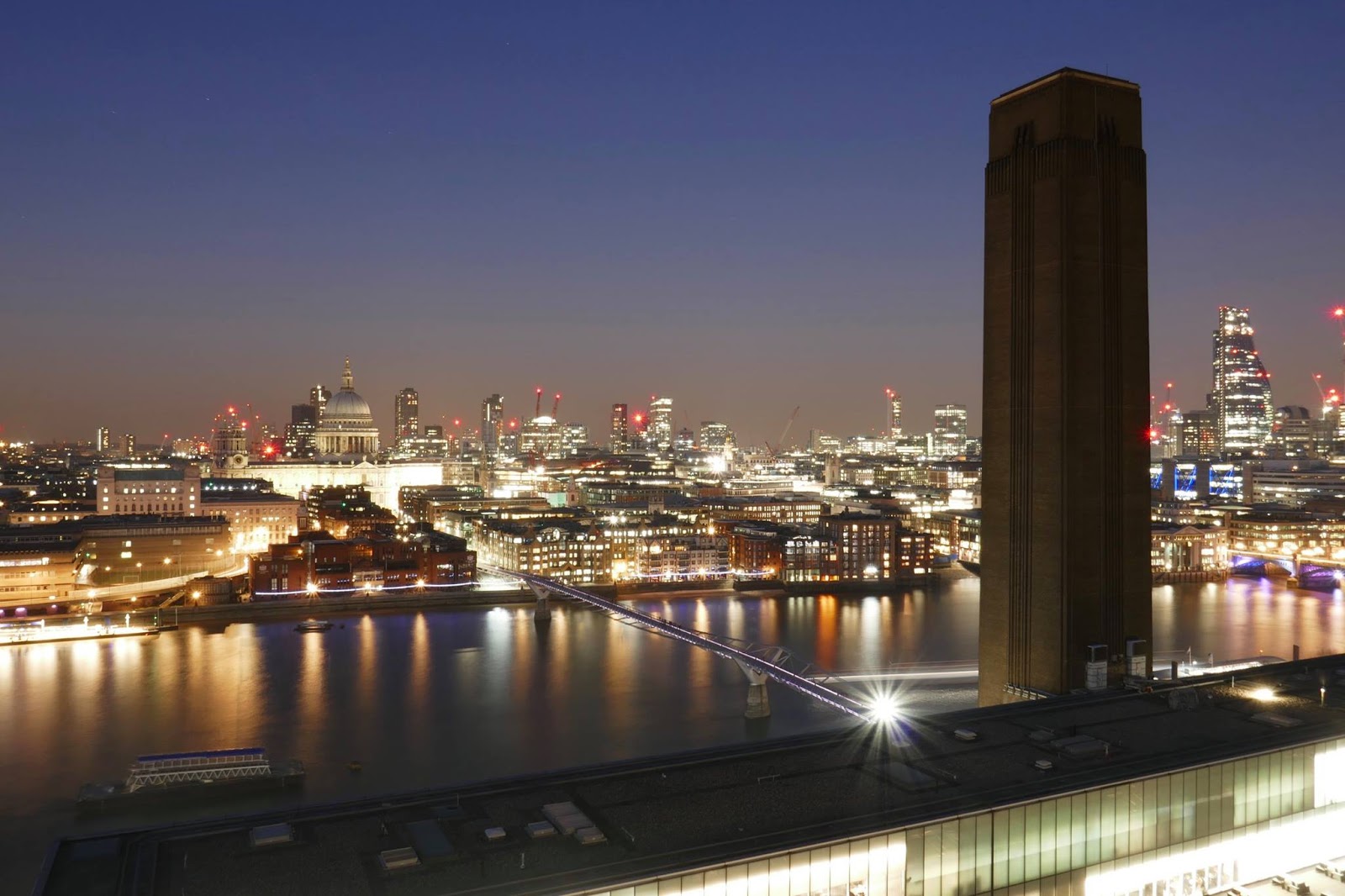
Many years ago, I watched as an abandoned power station in the middle of London was transformed into the Tate Modern, a shiny new gallery of contemporary art. For several consecutive summers towards the end of the 1990s, I was working practically next door, and year by year I could see the immense changes that were taking place both within and outside the enormous old brick building, as it transitioned from one use to another. At the time, it was the most obvious, but by no means the first, act of regeneration along the Southbank, and on this stretch of Bankside in general. The original building, constructed in two stages between 1947 and 1963, was designed by Sir Giles Gilbert Scott, famously the architect of several other British design icons, such as the red phone box and the Battersea Power Station, and its revamp was designed by Herzog & de Meuron.

There used to be enormous earth bunds between the building and the river, which in the summer served as miniature amphitheatres, in which outdoor Shakespeare performances were held. These earthworks were eventually removed, to make way for grass lawns, which inevitably could not stand up to the enormous use of the gallery visitors, quickly becoming scrubby mud patches. The Tate Modern development followed the opening of Shakespeare's Globe and, at around the same time, the Millennium Bridge across the Thames was constructed. The Tate Modern opened on 11 May 2000, the old chimney initially topped with a light-box, which changed colour.

The Millennium  Bridge opened on 10 June 2000, but closed again for modifications on 12 June 2000, owing to its now infamous "wobbliness", caused by a resonant structural response. After remedial works to install motion dampers, to stop the sway caused by pedestrians, it finally reopened on 22 February 2002. To this day, some people who are unfamiliar with London, and who want to make a snide point about modern architecture, seem to like to refer to it as the "wobbly bridge", despite the fact that it has not had a significant recurrence of its initial design flaw since reopening.

Looking back, on a period of time that is now almost 20 years ago, it is hard not to feel a little nostalgic for the sense of optimism and forward thinking. I remember many happy times spent in the Founders Arms pub, a glass box on the edge of the river, which was also extended at around the same time, but all things change, and time moves on. For the Tate Modern, the most recent example of this is the "Switch House" extension, which has now opened behind the original power station building (again designed by Herzog & de Meuron), from whose viewing gallery one can have, for free, one of the best views of London.

Now, sitting in the Member's Room, on the eighth floor of the new extension, I'm feeling nostalgic, but looking out at a view of the Thames and across to the West End that would have been completely impossible twenty years ago. Despite its changes, this stretch of Bankside remains one of my favourite parts of London, even if I no longer feel that I belong to it, or it to me, quite as much as half a lifetime ago.

Thursday, 21 July 2016

Hidden glory


There are times when small moments of wonder surpass more demonstrative spectacle. An example of just such a moment is to be found in the tiny church of All Saints' in Tudely in Kent. From outside, it is not particularly different from many other churches in Britain, with its squat brick tower and porch. Inside, however, it is hard not to be moved by the thing that makes it stand out from the rest, indeed from any other church in the world, and that is its stained glass windows, all of which were created by Marc Chagall.

The Chagall windows began in 1967 with the east window, pictured above, which was commissioned by Sir Henry and Lady d'Avigdor-Goldsmid as a memorial to their daughter, Sarah, who had died in a sailing accident in 1963, at the age of 21. This background is reflected in both the colour and the imagery of the window, above which is a horse, which some have identified as symbolic of freedom or love. Although the reason for the window's creation is tragic, the colour of the window and the way in which the eye is drawn upwards, creates a strongly uplifting feeling, in keeping with many of Chagall's other works.

It is said that Chagall was reluctant to accept the task of creating the memorial window, but that when he visited for its installation, he said of the little church, 'It's magnificent. I will do them all.'  The rest of the church's windows were installed in 1985, the year of Chagall's death, and now the church is open to everybody to marvel at them. Apart from the rarity of an entire church with windows by such a prominent artist, and their undeniable beauty, the fact that they remain in the space for which they were designed, with all of the meaning that goes with that, renders them truly magical.

At Tudely, because the church is so small, the majority of the windows are at eye level and one can stand close to them. This means that it is possible to become completely immersed in them, to be bathed in their colours, and to see the hand of the artist. When transplanted into the sometimes antiseptic environment of an art gallery, some otherwise great art can lose its spark, and it is easy to forget the context for which they were created. Here, the work still feels powerful and relevant, and it is a joy to behold.


Monday, 13 June 2016

Waiting for the Ghost Train


Tucked away behind undergrowth and wire fences, near the A66, beside Bassenthwaite Lake (the only "Lake" in the Lake District, tedious pub trivia fans; all of the other lakes are actually "Meres" or "Waters") stands the crumbling remains of what was once Bassenthwaite Lake railway station. The station was part of the Cockermouth, Keswick and Penrith Railway but, along with the rest of the line west of Keswick, closed on 18 April 1966, just over a century after it was opened.

I have always found something rather fascinating about exploring old ruins; as a child, I braved the wildly overgrown ruin of a large house at the end of my village, and for a long time afterwards was obsessed with the vacant rooms I had found, with tantalising hints of their former grandeur. Even today, I love the strangely surreal atmosphere of coming across buildings slowly being reclaimed by nature. So it was, having finished a short hill walk in the Lakes earlier in the year, that I realised I would be passing the ruins of the old railway buildings on my way to my hotel.

Some time before, whilst distracted at work one day and exploring Google Streetview, I had seen the ghostly outline of the old station building beside the main road. There has (and remains) some talk of reopening the line between Penrith and Keswick, which greatly appealed to me, although I fear that it may remain a unrealised dream of enthusiasts. Wist reading about it, I had been looking into the old railway that served this part of the Lakes. Later, I read The Lake District Murder by John Bude, in which the main characters frequently travel up and down this line, investigating shady goings-on, and was curious about this one of many abandoned railway lines. Since its closure, the Keswick to Cockermouth stretch of the railway has been built over, as the A66, which means that, with a little effort, one can imagine a little of the old journey.

I parked the car up a side road and approached the remains of the station building. It roof having been removed (or collapsed), it was clearly in a bad state and it was fenced off, with signs warning against trespass. Not wishing to do so (and, anyway, being unable to find a practical way through the fences), I walked around to the front of the station, along what I realised would have been the track-bed in front of the platform. The elegant wooden waiting room, also without its roof, was still recognisable, with its red and cream panels fading and overcome by mildew, and I could make out the ticket window in what I presume was the station master's office beside it.

Walking along the platform, whose edging stones remained beneath a carpet of moss, it did not take a great deal of imagination to see the building in its heyday, although somehow this made its current state all the more forlorn and sad. For a functional building, it had been created with very pleasing elegance, as I suppose was the way things were done in the 1860s. I wondered whether the craftsmen who laid the stone and created the woodwork ever considered that there might come a time when their hard work would be left to fall apart, but then reflected that few of us think of the future like that. It had been a smart building on a railway line, and presumably something that its station master and railway staff had devoted time and care to maintain, but its time had passed.

Returning to my hotel along the A66, I passed several other obviously railway-related buildings, which had now become homes, and was pleased to think that something of the old railway, beside the course of its old line, remained and was in regular use.

Wednesday, 13 April 2016

Feeling sheepish


The Lake District has a number of famous inhabitants. Depending on who you ask, they might mention Dorothy and William Wordsworth, Samuel Taylor Coleridge and the other Lake Poets,  Beatrix Potter, Arthur Ransome or Alfred Wainwright, author of the famous Pictorial Guide to the Lakeland Fells. For other people, some of the most famous residents are there still, and will carry on doing so for many years; not the humans who call Lakeland their home, but the Herdwick sheep, 99% of whom are estimated to live in commercial flocks in the central and western dales of the Lake District.

Herdwicks are especially robust animals, and live solely on forage, but tend not to stray, which makes them especially suited to the hills of the Lake District. For those of us who do not farm, the Herdwick sheep are also very distinctive, with their brown wooly bodies and faces seemingly with a perpetual amicable smile, and many people, me included, find them endearingly charming. This pleasing visage is perhaps what prompted the Herdy Company in England to produce a range of Herdwick-inspired products which, with their stylised Herdwick face peeping out, can be found in shops all over the Lake District.

Seeing the Herdwick sheep, perhaps as much as the familiar outlines of the Lakeland Fells, is one of the ways that makes me feel that I have arrived in the Lakes; little brown clouds pottering across the slopes and fields beneath the peaks. It's at least partly because of that pleasing symbiosis that I have a Herdy mug on my desk, when I'm not out walking the Lakeland fells.

Saturday, 19 March 2016

All the world's a Globe


The London I used to know from my youthful ramblings, twenty - goodness me, is it really twenty? - years ago is, slowly but surely, giving way to a polished, sandblasted, homogenised version of its former self. For example the old Globe Inn in Borough Market (which, to be honest, I never went in twenty years ago, because it looked far too scary) has literally been sandblasted to a bright London-brick yellow, which looks both clean and yet also pretend, like a film set's painted plaster wall, masquerading as the real thing.

This is a little ironic, I suppose, as I recall coming across the filming of the first Bridget Jones film, which was being made here in 2000, and discovering that a completely fake set of railway stairs had been inserted under the arches beside the pub (in the flat above which is where Bridget Jones lived, in the film). Even then, the fake stairs had art-department painted bird droppings and graffiti to make it look authentic. At the same time I am reluctant to be unduly critical of the motivation to reclaim or repurpose otherwise near no-go areas for general use.

This area, for example, used to be grotty, smell of rotting food waste from the market, and be best walked through at a reasonably swift pace after dark. It's just that the edges have been  knocked off, smoothed over, and sanitised. It seems improbable that the "characters" of old - Jeffrey Bernard, Peter O'Toole and the like - would thrive in this cleaner, gentrified, non-smoking version of London, but then perhaps their time was an anomaly - a symptom of their own post-WWII era.

I get the sense that there's a tussle going on, between the forces of regeneration and the original residents and users of the space. During the week, between 2 a.m. to 8 a.m., Borough Market is still, as its name suggests, a real wholesale market, selling fruit and vegetables, as it has done since at least 1276 (or maybe since 1014, according to the market itself, "and probably much earlier").

From Wednesday to Saturday, however, it also becomes home to stallholders, selling a wide range of food and drink from across the country and abroad (inevitably, there are a lot of "artisan" products and producers), and it is a destination in its own right for foodies and visitors after interesting tastes. Quite what the early morning vendors make of the later tenants, I don't know, but it would be interesting to see the handover between the two.

Sunday, 21 February 2016

Who nose?


There is almost always something unusual to see in London, if you are on foot, are reasonably observant, and are in the right mood. Sometimes, the things worth seeing are large and obvious, like a film shoot (which always makes me childishly excited) or a statue; other times, the things are small, like an unobtrusive sign pointing towards a "Roman Bath" (as may be seen on Surrey Street), or a brass plaque set into a wall or pavement. Regular readers may already have an idea that I enjoy spotting blue (and other coloured) plaques, commemorating the home or workplace of famous people from history.

On Admiralty Arch, between The Mall and Trafalgar Square, is a particularly small object of interest, and it's one that is often overlooked by passers by. Attached to a wall on the northernmost arch is the nose you can see above. It looks as if it is made of bronze, but I understand that it is made of plaster of Paris and polymer, and it is attached to the wall about eight feet from the ground. I cannot recall how or when I first became aware of it; I might have read something somewhere and gone looking for it, or I might have just spotted it, as a slightly incongruous protuberance on a large public building and landmark.

However I came to find it, I like that it is there. Apparently, it was placed there in 1997, along with around 34 others in various locations around the city, by artist Rick Buckley (www.rickbuckley.net) as part of a campaign against the "Big Brother" society. According to an Evening Standard article in 2011, approximately ten of Buckley's noses remain, including in front of Quo Vadis, a restaurant and private club in Soho, and somewhere outside St Pancras Station.

An odd thing about the noses, which only now occurs to me, is that - possibly because they are of such a mundane object, the human nose - one may be aware of them, but then forget about them when they are out of sight. I have a vague feeling that I have seen the St Pancras Nose which, from the photos I have seen on the web, appears to be a clay red colour, to blend in with the bricks to which it is attached, but I am not absolutely certain. There's something pleasing, however, about a work of art that retains a slightly covert character; although they are not hidden, you will only find them if you seek them out, or discover them by accident, and either way, if you do come across one, I challenge you not to raise a smile.

Thursday, 18 February 2016

Steam work


The mighty steam engines that surround the enormous turntable in the Great Hall of the National Railway Museum in York can take away the breath away. Partly, it's the fact that several of the engines gathered here (and the engines on display change, from time to time) are not just the fun little steam engines from most remaining steam railways, but are the enormous giants of steam history - Mallard, the Duchess of Hamilton, the Evening Star. These steam engines are at once beautiful and physically imposing, like mighty wild animals that have - just about - been tamed.

I first visited the National Railway Museum around thirty years ago and, whilst I think I have retained a vague sense ever since of the presence of the engines, for some reason the place was not entirely familiar when I went back recently. Doubtless, this unfamiliarity may have had something to do with a change in displays, and in museums in general, over the intervening three decades, but as I walked around these shining testaments to engineering, it dawned on me that I was experiencing them from an entirely different level to last time. Aged around seven or eight, I was probably a couple of feet shorter than today, and the engines around me must have been even more vertiginous and awe inspiring than they are now.

Visiting today, one doesn't need to remember what the experience of viewing these machines was like as a child, however, because there's something immensely childlike about being allowed to be in close proximity to such vast objects. I realise that plenty of people find great joy and fulfilment in watching modern trains go by, and I am certainly not going to mock trainspotters; the fact remains, however, that, by and large, modern trains don't manage to capture the same sense of excitement, of sheer raw almost animal power, as their ancestors.

The old trains, in comparison, along with the obvious mechanics that make them go - steam pipes, pistons, cylinders, crank shafts - they can also be almost heartbreakingly beautiful; the Duchess of Hamilton (the red train in the picture, above, designed by William Stanier) is "streamlined", meaning that she hides her boiler and pipes beneath a curved red ballgown of immense elegance; Mallard (the blue train, above, designed by Sir Nigel Gresley) is a stylish and graceful curve that one can easily imagine carving a path through the night air, art deco clouds billowing in its wake.

The other thing that makes these objects so fascinating, so enigmatic and worthy of attention, is the knowledge that, when they run, they are genuinely alive, in a way that diesel and electric trains just aren't. Steam engines (in the UK, at any rate) rely on the burning of coal - and lots of it - to heat the water to make the stream that drives the pistons that turns the wheels. This belly of fire, like a dragon's, relies in turn on the hard manual work of a fireman (and it does usually appear to have been a man's job) physically shovelling coal - tons of coal - into the firebox.

Today, standing in the cab of the Mallard, it's hard to imagine how it must have felt when engine was at full speed (it still holds the world speed record for a steam engine, which it reached on 3 July 1938, of 126 mph (203 km/h)). The heat, the roar of the engine, the fire and the wind, and the smoke and dust from the coal are almost unimaginable, but time spent among these mighty beasts is the closest many of us are likely to get to what must nevertheless have been a thrill.

Tuesday, 26 January 2016

Shelling out for the underground


Margate, on the northern coast of Kent, is an unusual place. On a sunny day, and they do occur, the beach around which it is set presents an appealing arc of sand, along which a glittering sea laps, attractively. To one side, the striking Turner Contemporary art gallery - a modern addition to the waterfront, and an attempt to trigger wider investment - draws the eye and a lot of visitors who, but for its existence, would probably have come nowhere near this otherwise somewhat dilapidated seaside town.

This is partly because, behind the gallery and seafront, lurks Old Margate. Bits of it, without question, are attractive and interesting, and blue plaques record the home of John Le Mesurier and Hattie Jacques (whose birthplace is also marked, here), and the building where Eric Morecambe and his wife held their wedding reception. Other parts of Old Margate are, regrettably, more problematic. Like many British seaside towns, with the rise in package flights to sunnier climes, Margate suffered from the decline in "traditional" seaside holidays, and its descent towards (if not downright into) borderline poverty is etched on its crumbling buildings and neglected spaces.

Walking away from the sea front, past buddleia-bedecked derelict sites awaiting money or inspiration, or both, the atmosphere, whilst not exactly threatening, is nevertheless somewhat less than welcoming. All towns and cities have their slightly unloved, but ultimately utilitarian, areas and Margate is hardly to be blamed for appearing to have more than its fair share of them. Nevertheless, the further from the sea we walked, the less sensible the plan that we had seemed to be.

Eventually, the road we were seeking came into view, and we turned left, climbing up a sloping and otherwise entirely residential-looking street. A little way up, on the right hand side, was the entrance to the building we were looking for, if "building" is quite the right word. We had arrived at the "Shell Grotto", an underground passageway, in essence, lined with shells; an exceedingly strange attraction, in an extremely unlikely location.

After paying our entrance fee, we wandered into a small back room, which contained background information on the grotto, such as it is possible to ascertain, which does not appear to be much. For example, one of the signs posed the questions, "Why was it built? When? Who by?" and answered them concisely with, "We don't know."

Descending a small stairway at the back of this room, we found ourselves in the grotto proper. A shell-lined circular underground corridor with an arched roof leads to a small atrium with a domed ceiling, through which daylight enters. Beyond this, a further passage gives access to rectangular room known somewhat sensationally as the "altar chamber", one end of which is blank cement, a testament to bomb damage from the Second World War.

As with a lot of the Grotto, definite information is sparse, so whether it was part of some religious temple, or just somebody's crazy whim is impossible to say; the grotto appears to have been discovered (or, at any rate, its existence made public) in 1835, but other than that, the rest is largely speculation, including just how old it actually is. Whatever the reason, date or individuals behind its creation, it remains an arrestingly odd place, and definitely worth a visit. Just don't go expecting to learn anything very definitive, other than perhaps what it is like to be in a shell-lined tunnel underground.

Sunday, 24 January 2016

Wainwright away


Between 1955 and 1966, Alfred Wainwright published seven volumes of a pocket-sized walkers' guidebook called "A Pictorial Guide to the Lakeland Fells". In the course of doing so, he identified 214 hills and mountains (known as "fells") in the Lake District in Northern England which have come to be known, collectively, as "the Wainwrights". For those of us who are so inclined, myself included, it has become a common past time to walk or "bag" those fells and to "do the Wainwrights".

Not all of us, however, have ready access to the Lake District, and so the process of walking all 214 fells can take several years. Fitter and, for the slower among us, more annoying people have achieved the same thing in six or seven days, but I like to think that they could hardly have savoured the experience. Another advantage about the process being more drawn out is that each time I return to the Lakes, I experience anew the sensation of joy and happiness that comes from the effort of propelling myself over beautiful landscape, with often even more stunning views around me.

And so it was this weekend, when I returned to the hills, almost ten months after my last visit. Having started my car journey pleasingly early, I arrived in the North Lakes in good time to climb Binsey, a low Wainwright, somewhat detached from the main bulk of fells that he catalogued. As it can take me at least five hours' driving to get to the Lakes (sometimes as much as seven or eight, if the traffic is against me), I have occasionally considered some Wainwrights as "expensive", meaning that the effort required to get to and then walk them is relatively great.

If I were to have travelled here to climb Binsey on its own, and nothing more, it would have been an extremely "expensive" hill, being only 447 m (1,467 ft) high, and so removed from its neighbours that it would not have been particularly practical to combine it with any other hills. As it was, I had a longer walk planned for the next day, so this was a bonus. Being only a pleasing 50 minute climb there and back from the car, this gently walk was also exactly what I needed after my drive.

Looking back south over the Skiddaw massif and Bassenthwaite Lake (the only "lake" in the Lake District, trivia fans; the others have "mere" or "water" in their names) having reached the modest summit, I felt refreshed and renewed, almost instantly. The fresh air, the bright sunlight, the endorphins, all combined to blow away the cobwebs that can accumulate, living predominantly indoors over winter, and I found myself grinning broadly, despite myself.

The next day, I walked and walked and walked. I had been planning to climb two other Wainwrights, but as I wandered over the fells, and saw the proximity of several others, I ended up climbing five. I turned back from a possible sixth, as the wintery wind filled with razor-sharp droplets of freezing rain, which pinged harshly against my face, but I was still satisfied. Looking back, on my way off the hill, the wind and rain having abated and the sun breaking through the clouds again, I wished, for a moment, that I had pressed on, but you never know what the weather will do in the Lakes, and it could easily have got worse.

The hills will still be there another day, I considered, and it's always good to have something to come back to.

Wednesday, 20 January 2016

Hodge your bets


In Gough Square in the City of London stands the above statue to Hodge, Dr Johnson's cat (whose ears, I can't help but feel, are actually just a little too big). I first met this Hodge around Christmas time, one year, when he had a collar of tinsel, and a pleasingly festive air. He stands, on a plinth, outside Dr Johnson's house, on which is written "HODGE a very fine cat indeed belonging to SAMUEL JOHNSON", repeating a quotation attributed to him in in James Boswell's Life of Johnson. Dr Johnson is supposed to have said of his pet "He is a very fine cat, a very fine cat indeed."

There is something deeply humanising about hearing about how famous historical figures interacted with their animals, and indeed the names they gave to them. Hodge is a great name for a cat, but I think that I slightly prefer the name given by Edward Lear to his tubby tabby cat - Foss. I have also always liked the story about Hodge, again told by Boswell, that Dr Johnson would go out himself to buy oysters for his cat, rather then make is servants do it, so that they wouldn't dislike Hodge for having been put to extra work.

Friday, 8 January 2016

As I was going to St. Ives...


      As I was going to St. Ives,
      I met a man with seven wives,
      Each wife had seven sacks,
      Each sack had seven cats,
      Each cat had seven kits:
      Kits, cats, sacks, and wives,
      How many were there going to St. Ives?

So runs the famous riddle. I suppose it still counts as a riddle even if there is no clear or widely accepted answer to it, but that doesn't make it any less irritating. It also quite neatly sums up some of my objections to mathematics, as as subject, an aversion which probably dates back to my school years. I can still vividly recall, as an eleven year old boy, being given an impromptu maths test that included the question, "If it takes four minutes to boil one egg, how long does it take to boil eight eggs?" Naively assuming that, in a maths lesson, it was a maths, rather than a cookery, question, I dutifully multiplied four by eight to answer "32 minutes". Of course, the answer was four minutes, because you can boil all the eggs at the same time, not that boiling even a single egg was something I think I had done at that age. Any possible interest I may have had in maths died that moment, and thereafter I considered the subject to be annoying, tricksy and deceitful.

All of which is a surprisingly negative way of introducing a post about St. Ives, the little seaside town on the north coast of Cornwall, England; a place that I visited for the first time in 2015, and almost immediately fell in love with. I had been to Cornwall several times before, and had even done some volunteer work near Penzance on the south coast, but this was the first occasion that I had been to this part of the county. St. Ives is unashamedly a tourist village, and every Friday and Saturday the roads are jammed as one group of holidaymakers swaps over with the next set. Despite this, the place managed to accommodate all of these tourists without feeling overly spoiled.

It has come a long way from its origins, as a sleepy fishing village, but there is nevertheless a clear sense of a real community remaining beneath the seasonal tide of emmets (the Cornish name for tourists, from an old English word for ants - the logic speaks for itself). For many, the draw of St. Ives is the bright blue sea, and its warm sandy beaches. St. Ives is surrounded by bays, each of which offers something different for different people. For families who wish to sunbathe and paddle, there is the broad expanse of Porthminster Beach, with its cafes and restaurant. To the north west, there is Porthmeor Beach, which draws surfers and bodyboarders. Around the natural promontory known as The Island, between the two, there are three or four other little sandy alcoves, which slowly fill up with holiday-makers.

The town itself is full of the usual shops and restaurants that one would expect of the seaside, but St. Ives also has an outpost of the Tate Gallery, as well as a museum dedicated to the sculptor Barbara Hepworth, who used to live there (some of whose works are also dotted around the town). Tucked away in the winding streets of the town itself are dozens of little art galleries and shops selling a wide variety of attractive oddments. It feels like a creative place, and one where people are encouraged to be themselves.

I had had a hectic and stressful time before I arrived, and so I was more than content to swim in the sea, and wander the streets, never once getting back into my car. Slowly, over the following week, I began to feel myself unwinding, and the taste of salt water on my lips brought back pleasant memories of childhood holidays by the sea. One day, splashing about in the water, I was startled to see the head of an equally curious harbour seal in close proximity, which soon disappeared beneath the waves, leaving me uncertain as to what I had seen. Later that evening, walking along Smeaton's Pier, I was reassured to see two of these lovely animals rolling languorously in the shallow waters beneath. St. Ives felt very much at ease, with itself and its temporary inhabitants, and that sense of relaxation was exactly what I needed. 

Thursday, 17 September 2015

A plaque on both your houses


In these frantic times, it's good to take a minute now and then to remember some of our sadly lesser-known, yet nevertheless important, figures from history.

In my regular wanderings, I am frequently surprised by how little attention the average pedestrian (far less the average driver or gyrocopter pilot) pays to the plaques and memorials that dot or, if you prefer, pepper our streets. Sometimes these panels record interesting, successful or famous people; sometimes the locations of discoveries or events of great historical importance.

If only we looked up a little more, it sometimes seems to me, our lives could be enriched and enlivened by the thought of those who came before us (even if those thoughts should probably not, in all good conscience, always be considered to be entirely historically accurate).

This week, it's time to celebrate Dr James Yearsley, founder of the Metropolitan Ear Institute in London in 1838. Dr Yearsley is rightly recognised with this green plaque at 32 Sackville Street, Piccadilly, London, the site of his former clinic.

Without Dr Yearsley's tireless work and years of painstaking research, the chances are we still wouldn't have ears today or, as they were originally known in honour of their inventor, "Yearsleys". Queen Victoria who, for all any of us know, may have been a regular visitor to the clinic, is reported in Court circles to have been seen "grinning from Yearsley to Yearsley" after a successful appointment with the good doctor.