Friday, 20 October 2017
Can't make an omelette without...
Several months ago, I was sitting in the downstairs dining room of Eggbreak restaurant in Notting Hill. I had dropped in to have lunch, sit, and do some writing, and take advantage of an impressive and predominantly egg-based menu. The atmosphere was lovely, the serving staff charming, and the food amazing; I would recommend it without hesitation.
I would be lying, however, if I were to claim that I wasn't initially drawn to the place because of Lin-Manuel Miranda's Twitter recommendation, based on his period of living in the area during the filming of Mary Poppins Returns, but having found it, I felt very welcome there. Being the Hamilton nerd I am, I'm not going to claim I wasn't also a little excited to have been seated at the table Mr Miranda had occupied.
As I sat finishing an after-lunch coffee and half a cake (the accommodating waitress having agreed to split it with me), I soon found myself distracted by the behaviour of an American diner who arrived, her personality seeming to occupy substantially more space than her slight frame would have suggested. Eventually, albeit with some unnecessary palaver, she sat at a table a couple of places to my right and surveyed the menu. Elegant and self-assured, she ordered, as I would go on to become well aware, something with poached eggs. For some reason, however, even the ordering process appeared to be more of a production than I would have expected and, a little later, her food arrived and was placed before her.
After a moment, she sampled her lunch and recoiled physically, with a loud and dramatic, 'Eugh!' and pushed the apparently offending plate away from her, with enough of a flourish to make sure everybody else in the restaurant was aware of what was happening.
It was at this point I realised, if I had not already suspected it, that the floorshow was about to begin.
The American lady called across the waitress and complained that her poached egg was cold. That, it turned out, was not the only problem.
'I always come in here,' she went on, 'and I always order the poached egg, and it's always cold.'
The waitress was apologetic, although quite understandably confused. She attempted to explain the process whereby poached eggs were produced, but the American lady was in no mood to listen.
'I know how you do it,' she said, loudly and firmly. 'They make them at the beginning of the shift and then put them in iced water for later. I know what they do.'
After some haggling, she ordered and, subsequently, consumed an alternative item from the menu, before leaving, apparently satisfied, but still pontificating about the poaching method of eggs. I was, at the same time, fascinated by her thought processes, and impressed by the politeness and professionalism of the waitress who was dealing with her. After she had gone, and the waitress came to clear her table, I felt I could stay silent no longer. As the waitress passed me, I asked the question that had been bothering me for some time.
'If she always orders it, and it's always cold,' I said, 'why doesn't she order something else?'
Tuesday, 12 September 2017
High above the High Street
There is a place that feels like it should not exist. Well, OK, I suppose there are many places that feel like they should not exit, but the one I am thinking of is the Roof Gardens high above Kensington High Street. I had been there several years before, for a work dinner, and at the time had been astonished by the place. A few months ago, whilst visiting the new Design Museum in Kensington, I decided to pay it another visit, and was not disappointed. To enter this strange world, you have to present yourself at a reception desk behind a door up a side street, and provide some ID. By and large, you don't have to book, and entrance is free. After signing in, you are pointed towards a lift lined with pictures of flamingos, and are sent to the top of the building.
When you emerge, you are in a somewhat anonymous corridor, but after wandering around a little, you emerge into the daylight where you may find yourself, miraculously, in a Spanish garden, a medieval courtyard, or an English woodland. All six stories up, beside a busy London thoroughfare. The unreality of the place brings to mind the original film Westworld, and from certain angles, you could easily be forgiven for believing you were in Grenada, or the grounds of a well-preserved Tudor mansion. Only the spire of St Mary Abbots church peeking out over the moorish colonnade, perhaps, gives the game away.
The gardens opened to the public in May 1938, having been built over the course of two. The original idea came from Trevor Bowen, the vice president of John Barker & Co., the original owners of the building on which the gardens sit. He hired the landscape architect Ralph Hancock to turn his idea into reality, which Hancock did to incredible effect. Appropriately enough, although they take a little finding, being hidden away in one corder of the woodland garden beside a quirky 1930s house, there are plaques to both gentlemen, commemorating their work.
The garden is not just an oasis of calm in a busy city, although it assuredly is this; it is also a miniature wildlife garden. Walking from the Tudor garden to the woodland, past natural-looking ponds (six floors up, remember) you are likely to come face to beak with the flamingos pictured in the lift, along with a variety of exotic ducks. On a bright, quiet, weekday morning, I walked around this delightful folly, which I had largely to myself, and felt like I had travelled to another world.
221B or not 221B, that is the question
Sherlock Holmes arouses fierce passions in some people, which may be regarded as unusual, given that he never actually existed. This existential hindrance has not, however, prevented thousands of people across the globe writing to the famous (fictional) sleuth for assistance, as evidenced by the book "Letters to Sherlock Holmes", and the presence of the Sherlock Holmes Museum on - where else? - Baker Street in London. Strictly speaking, and despite the number above the doorway to the contrary, this is not 221B Baker Street, but 239 Baker Street, although as with anything with its origins in fiction, we must allow quite a wide leeway for suspension of disbelief.
I thought of my visit to the Museum recently, having passed (for the millionth time) the Sherlock Homes pub in Northumberland Street near Charing Cross. For some reason, on this occasion, I decided to take a look inside, because I knew, and had known for many years, that the pub contains a replica of Holmes' apartment on the first floor. This was originally an exhibit for the 1951 Festival of Britain, put together by Marylebone Borough Library and the Abbey National, and I was pleased to see a small plaque outside the pub confirming it was still there. One might wonder why the Abbey National would have been involved in such an exhibit but, from the 1930s until 2005, the bank actually occupied 221B Baker Street, and had a full-time secretary to answer mail addressed to Sherlock Holmes.
The exhibit in the Sherlock Holmes pub is smaller than the Museum, being limited to one small room (above), although it does contain a wax bust of Holmes, bullet hole and all, which Holmes fans may recognise from The Adventure of the Empty House. It took me a long time, however, to spot the Turkish slipper beside the fireplace, containing tobacco, which is a detail of Holmes' consulting room that always caught my attention. The Museum also has a Turkish slipper and, to my delight, also has "VR" in bullet holes on the wall, as described in The Adventure of the Musgrave Ritual. Nevertheless, the little exhibit reminded me of my visit to the Museum, a few years ago.
The Museum is an altogether odd place, although none the worse for that. My favourite part was the living room, where most of the stories begin, although in the upper rooms are eerily lifelike waxworks, including one of Professor James Moriarty, which are just realistic enough to make you wonder if they might be about to move. I have long enjoyed the Sherlock Holmes stories, and went through a period of reading the complete works (finally giving up towards the middle of the final book, when it became apparent that Sir Arthur Conan Doyle's heart really wasn't in it any more). The Museum is filled with clues (appropriately enough) to many of the stories (including the "stuffed" head of the Hound of the Baskervilles), and one can spend a pleasant time wandering around the little house, trying to spot them.
Not too far from the Museum, if you are in the mood, is 187 North Gower Street, which is the location for 221B Baker Street in the BBC's recent series Sherlock. It is also, as a blue plaque testifies, the former home of Giuseppe Mazzini (1805 - 1872), an Italian politician, journalist and activist for the unification of Italy. If you have seen the programme, and this is news to you, that is because the blue plaque is hidden behind set decoration (a distinctive round light). With the success of Sherlock and the CBS show Elementary, both of which reimagine the detective in the modern world, there seems to be no likelihood of interest in the original resident of 221B Baker Street ending soon.
Wednesday, 31 May 2017
Iceland ahoy!
It was early Sunday morning in Reykjavík, and peering slightly blearily out of the apartment window, for I had not slept well for over 48 hours, I was immediately cheered a little by the sight of a beautiful sunrise. I had until early afternoon to explore this pretty little city by myself, before getting the bus back to the airport, and I resolved to get out as soon as possible, to see as much as I could. It is lovely to travel with company, but there is something special about being able to follow one's own whims and just wander about aimlessly, that can be extremely pleasant. I had few places that I definitely wanted to see, and was happy to just look around, but before doing anything I needed a coffee.
Something that struck me about the little bit of Iceland that I visited was the high density of American visitors. Siting in a café on Bankastræti, a little later that morning and having dumped my bags with the nearby tourist information office, I looked around at my fellow patrons. Even at this early hour, there appeared to be one or two native Icelanders, but six or seven Americans. The day before, when visiting the Blue Lagoon, Americans had again made up a vast majority of bathers. Of these, a large number appeared to be too squeamish to follow the hygiene instructions about showering naked, or even at all, before entering the water. I have nothing against Americans (and love New York dearly) but some of the Americans in the café this morning, particular the younger, more excitable ones, were more than a little annoying. Two American girls, for example, appeared to find almost everything extremely funny, a situation that was made worse by the fact that one of the girls had a loud shrill laugh that sounded almost exactly like a swannee whistle.
A little fortified by coffee and a cinnamon bun, and keen t be on my own, I wandered out again into the cold morning. There had recently been a fall of snow, and I turned up the hood of my jacket against the cold, as I walked up a slippy path to visit a great statue of Ingólfur Arnarson, one of the founders of Reykjavík. Down by the waterfront, the glorious Harpa concert hall was looking particularly spectacular in the bright sunlight, and I decided to potter over to have a look, which proved easier said than done, on pavements as slippery as an ice rink. Opened in 2011, Harpa's glass facade reflects the sky and, at night, as I had first seen it a couple of nights before, a light display that dances across the panels resembles the northern lights (which, disappointingly, I had not seen).
Further along the waterfront, I paused at the Sólfarið (Sun Voyager) sculpture, shown above, by Jón Gunnar Árnason, although I found myself getting irritated by people who were standing around the work of art. The Sólfarið sits on a plinth that just out into the water, and was surrounded by visitors who were ignoring it and taking pictures of the view, and seemed not to notice or care that they were getting in everybody else's pictures of the sculpture. I started to wonder whether people were behaving unusually rudely, or if, in my sleep-deprived state, I was just being unreasonably judgmental.
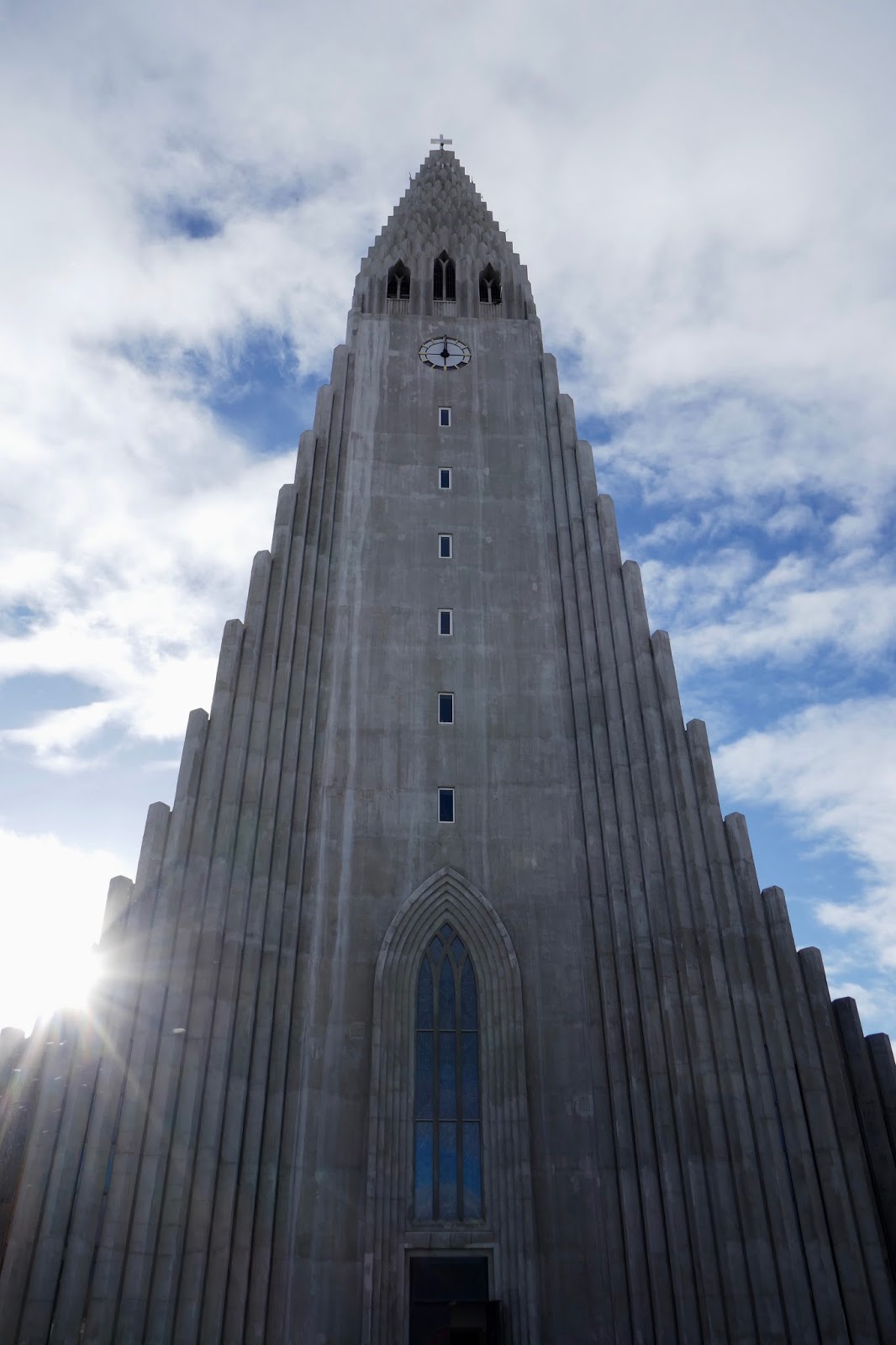
Putting the waterfront behind me, I walked back into the city and up the hill to one of the places that I had been anxious to visit: Hallgrímskirkja, the largest church, and one of the tallest buildings, in Iceland. I arrived just as the doors to the viewing platform were closing, but contented myself with looking at it from outside. Looking both natural and space age (construction began in the 1940s, but was not completed until the 1980s), it is an undeniably iconic structure, and one that towers over the city, being visible from many places.
After this, I wandered back into the city streets and had more coffee. I peered into a few shops, as ever finding myself most happy in a couple of lovely bookshops (in one, I bought a CD by Ólafur Arnalds, an Icelandic composer whose work I have loved for some time; in the other, along with another coffee, I bought a pair of socks). After I while, I began to realise that I was exhausted, but just walking and walking, possibly powered by too much caffeine, and that I would soon have to make my way back to the collection point for the bus to the airport. I had enjoyed my visit, but resolved to return, someday, and hopefully to explore more widely, and on substantially more sleep.
Sunday, 7 May 2017
Finding the 100 Acre Wood in the Big Apple
Ever since I was a child, I have loved the stories of Winnie the Pooh, the hapless yet courageous bear of very little brain, and his friends. I grew up reading Winnie the Pooh and The House at Pooh Corner, and having them read to me, and like many people, the stories are so familiar to me that I feel a personal attachment to them (although I have never taken to the Disney films of their adventures; to me, they are a pale imitation of the original). I still consider the ending of The House at Pooh Corner to be one of the most heartbreakingly beautiful conclusions to a book ever written.
The true story behind Pooh and Christopher Robin is reasonably well known (and is shortly to be the subject of a new film, Goodbye Christopher Robin); in the 1920s, writer AA Milne wrote the tales based around his son, Christopher Robin Milne, and his toys, and his charming poems and adventures soon became world famous. The real 100 Acre Wood, where the stories are set, is Ashdown Forest in East Sussex, was also somewhere I was taken several times as a child, and have visited again as an adult. Even today, the locations from the books are all accessible, and most are immediately recognisable.
For me, the 100 Acre Wood remains an Enchanted Place, and the characters in the books are so fundamental a part of my childhood, that the realisation that, on my first visit to New York, I had walked within just a few feet of their current home without going to see them was a sad one. Returning to New York last December, however, I rectified this omission, and the experience was as moving and as magical as I could have hoped.
How the New York Public Library come to be the curators of some of English literature's most famous toys has, over the years, been a sometimes acrimonious one, and I have no desire to revisit the debate. When I visited them, in their own glass case in the New York Public Library Children's Center, they had only recently returned, having been beautifully restored. I had seen earlier pictures of the toys, and the patchwork nature of earlier restoration was all too painfully apparent. Now, the toys look like themselves, by which I mean that they look like the illustrations by EH Shepard (with the exception of Pooh, whose fictional likeness was based on Growler, the teddy bear owned by Shepard's own young son Graham), and my heart filled with joy at being in their presence.
My favourite of the animals from the stores was always Eeyore, the eternally pessimistic, gloomy grey donkey. My affection for him might be down to a beautiful audiobook of the stories that I owned as a child, read by Lionel Jeffries. Jeffries gave Eeyore a lugubrious baratone voice of noble desolation, making the donkey sound like a long-suffering yet ultimately self-aware observer of the actions of the other animals. In New York, I was delightfully surprised to discover that Eeyore, the real physical Eeyore, actually has a smile on his face. This is not immediately obvious, because of the downward tilt of his head, which doubtlessly suggests dejection, but if you peek up at him, you will find that, underneath it all, Eeyore is actually happy. This made me happier still.
Before I left New York, I visited the toys one more time, to bid them farewell. I feel pleased that I got to meet them, and that they are in the hands of people who have treated them to the very best of care, bringing them back to life, so they can be adored by more generations of fans.
Friday, 28 April 2017
Concen-Tate
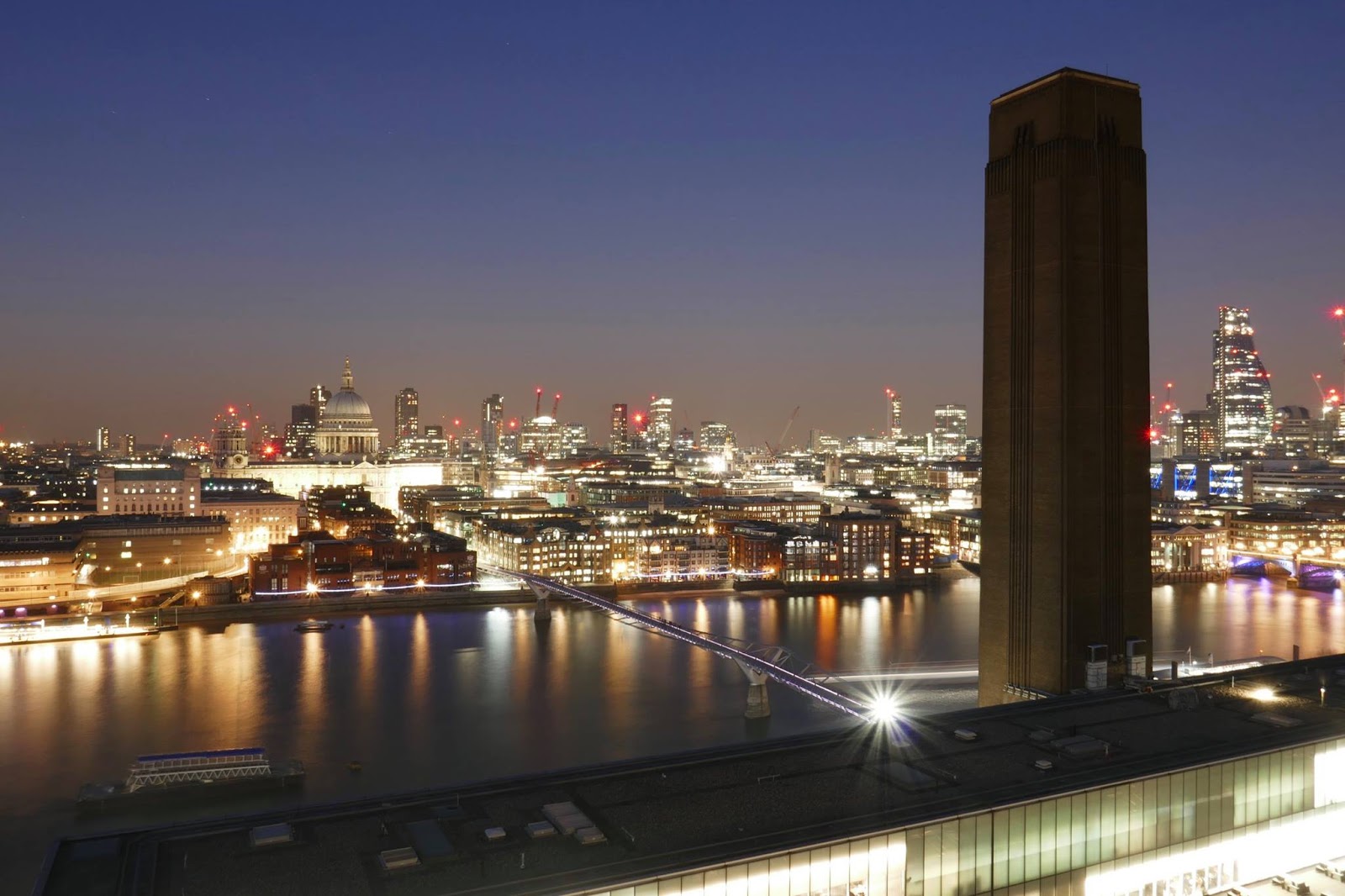
Many years ago, I watched as an abandoned power station in the middle of London was transformed into the Tate Modern, a shiny new gallery of contemporary art. For several consecutive summers towards the end of the 1990s, I was working practically next door, and year by year I could see the immense changes that were taking place both within and outside the enormous old brick building, as it transitioned from one use to another. At the time, it was the most obvious, but by no means the first, act of regeneration along the Southbank, and on this stretch of Bankside in general. The original building, constructed in two stages between 1947 and 1963, was designed by Sir Giles Gilbert Scott, famously the architect of several other British design icons, such as the red phone box and the Battersea Power Station, and its revamp was designed by Herzog & de Meuron.
There used to be enormous earth bunds between the building and the river, which in the summer served as miniature amphitheatres, in which outdoor Shakespeare performances were held. These earthworks were eventually removed, to make way for grass lawns, which inevitably could not stand up to the enormous use of the gallery visitors, quickly becoming scrubby mud patches. The Tate Modern development followed the opening of Shakespeare's Globe and, at around the same time, the Millennium Bridge across the Thames was constructed. The Tate Modern opened on 11 May 2000, the old chimney initially topped with a light-box, which changed colour.
The Millennium Bridge opened on 10 June 2000, but closed again for modifications on 12 June 2000, owing to its now infamous "wobbliness", caused by a resonant structural response. After remedial works to install motion dampers, to stop the sway caused by pedestrians, it finally reopened on 22 February 2002. To this day, some people who are unfamiliar with London, and who want to make a snide point about modern architecture, seem to like to refer to it as the "wobbly bridge", despite the fact that it has not had a significant recurrence of its initial design flaw since reopening.
Looking back, on a period of time that is now almost 20 years ago, it is hard not to feel a little nostalgic for the sense of optimism and forward thinking. I remember many happy times spent in the Founders Arms pub, a glass box on the edge of the river, which was also extended at around the same time, but all things change, and time moves on. For the Tate Modern, the most recent example of this is the "Switch House" extension, which has now opened behind the original power station building (again designed by Herzog & de Meuron), from whose viewing gallery one can have, for free, one of the best views of London.
Now, sitting in the Member's Room, on the eighth floor of the new extension, I'm feeling nostalgic, but looking out at a view of the Thames and across to the West End that would have been completely impossible twenty years ago. Despite its changes, this stretch of Bankside remains one of my favourite parts of London, even if I no longer feel that I belong to it, or it to me, quite as much as half a lifetime ago.
Tuesday, 1 November 2016
Great Gilbert Scott!
A number of years ago, when wandering along the Euston Road in London, I came across the then abandoned Victorian Gothic extravagance of the former Midland Grand Hotel, which fronted on to the St Pancras railway station. The original hotel, with its red brick spires and sweeping curved driveway up to the station, was designed by George Gilbert Scott and opened between 1873 and 1876. It ceased to be a hotel in 1935 and was used as railway offices until the 1980s, when it was shut down.
Today, it is hard to imagine a time when such a massive structure in such a prominent location could have been, effectively, abandoned, but this is what happened to the Midland Grand Hotel. In common with the nearby Kings Cross Station (which I have written about previously), the area appears to have been simply left to fall apart, and it was commonly known, when I was young, as almost a no-go area, famous more for prostitution and drugs than for its architecture, or as a desirable location in its own right.
When I walked past the building fifteen or so years ago, it was a sorry sight. Its windows were grimy and its original entrance was fenced off. Litter and dust collected on the wire fence and in its steps, whisked along by the wind-tunnel that is the Euston Road, and it was far from inviting. I was surprised, therefore, to see that a gate in the fence by the entrance was open, with a small sign inviting visitors to enter and explore. Always a fan of abandoned buildings, I looked around me, because despite the sign inviting me to do so, it still felt a little illicit, and walked in. I seem to remember a bored security guard sitting inside the front door, but other than that I was free to explore some of the ground floor rooms.
The building felt sad and unloved, with peeling paint, strip neon lighting, and damage caused by water leaks. One room, which I have since learned was originally the Coffee Lounge, had been stripped what I imagined to have been 1960s-era suspended ceiling, installed when it was an office. This had left a "tide mark" on the walls under the ceiling tiles, which had been painted more recently, and the old hotel walls above, which were of a different colour. Above it all was the original ceiling, still with grand moulded plasterwork, but punctured all over by holes from the installation of the suspended ceiling.
One of the most famous elements of the Midland Grand Hotel, even in its dilapidation, was the Grand Staircase. A striking feature of cast iron, with red and gold walls, it had been used in numerous films (such as Ian McKellan's Richard III) and music videos and, probably thanks to set dressing, was still recognisably that of a luxury hotel (even if it also had a hint of steampunk, with its mesh of industrial ironwork and faux Gothic stone).
I revisited the hotel again recently, as I was early for another appointment. It has been extensively refurbished and developed since I last visited, and it reopened in 2011 as the 5 star St. Pancras Renaissance Hotel London. The old entrance lobby (the new lobby is up the ramp, in what used to be the taxi rank) has been turned into a bar, from whose gloriously Victorian painted ceiling hang bells. As I walked back in, it was pleasant to feel life in the old building again, although I found the bar a little cramped, without feeling cosy. I usually like to sit in hotel bars and write, but I did not feel particularly inclined to do so here.
I walked past the Coffee Lounge, which is now the Gilbert Scott dining room, and registered how mightily it had been improved. Nevertheless, I felt a little sorry that this room, with its curved walls and windows looking out on the city, was not more of a public space, as I imagine it might have been originally, but at least it is being used. The Grand Staircase is as gloriously crazy as it was, but now with a deep pile carpet. Since the lobby has been moved, there feels like less of a logical connection between it and the rest of the hotel, as it was originally designed, and I did not feel inclined to sit here either, but perhaps the experience is different for those who stay and use the rest of the hotel's amenities.
I left the hotel feeling pleased that it had been salvaged from its state of ignominious abandonment, but slightly disappointed not to have felt more welcome, although perhaps that is partly a fault of the original design (in its first incarnation, after all, it only survived as a hotel for about 60 years). The architectural style is not to everybody's taste, which is one of the reasons it was been abandoned for so long, but thanks to creative thinking and massive investment, it now has another life, one that it playing its part in revitalising the wider area.
Wednesday, 14 September 2016
Long way up
Recently, having returned to the Lakes to try and tick off some more of the Wainwrights, I had a full hand of the above irritations. I had slept badly, and as I trudged to the start of my walk, the valley was overcast, with the cloud sitting discouragingly low on the hills I was proposing to climb. Nevertheless, it had stopped raining, and I started my walk, determined to at least give it a go, before the weather and my own dozy sluggishness defeated me. Very soon, it turned from wet to warm, and I had to remove my rainproof jacket. Even then, it felt like walking in the tropics, and my glasses refused to stay on the bridge of my nose, but repeatedly slid down on a slick of sweat that poured off my reddening face.
Slowly but surely, I reached the top of Seathwaite Fell (a hill of around 600 metres in height). There, sitting by Sprinkling Tarn, I ate some lunch, and drank a small bottle of orange juice with indecent haste to try and quench my parch. Across the little body of water, I could make out the lower slopes of Great End; at 910 metres, the highest hill I was aiming for. I say "lower slopes", but I suppose I really mean "cliffs", and it was far from clear where the route I had picked out on a map actually led. Having fed, I headed towards the cliff wall, and scanned it again for a way up. Eventually, I made out The Band, a kind of breach in the hill's ramparts, which was supposed to lead to another path that would eventually climb up the hill.
I am not a walker who disdains the SatNav, and today I found mine particularly useful in confirming where on the bleak side of this hill I actually was. SatNav can only lead you so far, however, and I was fortunate, eventually, to pick out the subtlest hints of a pathway leading up the apparently otherwise unassailable rock. To the experienced walker, the polish on well-worn rocks and the occasional line of grit amongst the native rocks are all indicators that you have not lost you way, and I was relieved to follow them. Then they abruptly stopped at a twenty foot high wall. I looked up at it. There might, it occurred to me, if one was feeling adventurous, be just the barest hint of steps, but I was walking alone, and was wary about getting myself rock-bound; that terrifying sensation of being unable to go forward or back, without the risk of a fall and a breakage.
I retraced my route a little and scanned the rocks around me. No, I had followed the right route; this was it. I returned to face the mini-cliff and reevaluated the scariness. On reflection, it seemed slightly less terrifying, and before I knew it, I had scrambled up it, and onto the next stage of the climb. I am not normally a walker who enjoys scrambling, but as the climb progressed, I found myself enjoying the mental as well as the physical exertion. One of the greatest things about walking is its capacity for clearing the mind of everything but the essential. One cannot worry about deadlines and other work problems, when you are also at least partly focused on not dying, for the moment.
Eventually, the gradient lessened, and I finally took a moment to turn around and see where I was. For the last half hour or so, I had been climbing in the mist, so I was not expecting to see very much. It was with a tangible surge of emotion, then, that almost as I turned, the cloud lifted, and I found that I had an exceptionally glorious view all the way down to Derwent Water, about six miles away. I breathed deep of the clean mountain air, and grinned. This, I muttered to myself; this is why I do this.
Monday, 12 September 2016
I'm not afraid of any ghosts
God, but I love New York. Even before I visited it, I think that I had been building up to loving it, having been quietly indoctrinated by watching countless movie and television representations throughout my whole life. Nevertheless, I was dumbfounded by how much - and how hard - I fell for the city. Even now, over a year after my first visit, I feel an enormous sense of almost proprietary pride in the place, and a passionate longing to return to it, whenever I see something about it.
Perhaps, films aside, it has something to do with the truly international nature of the city, almost more than any other I have visited. An example of this was driven home to me, whilst wandering the galleries of the Metropolitan Museum of Art, almost obscenely overstuffed with art from all over the world. My attention was drawn, in particular, to a bust of Caroline Campbell, Lady Ailesbury, created by her daughter, Anne Seymour Daimer, Britain's first famous woman sculptor. The sign beneath it noted that a copy existed in a church in England, and my girlfriend asked me if I knew it. I replied that, yes, I knew it. My parents had been married there, and it was where I had been Christened.
For all the high culture, it is also hard when walking around the city, not to be distracted by the many many famous film locations one comes across. In the year that has seen a new Ghostbusters (brilliant, go see it), I was reminded of finding the iconic firehouse (more correctly known as Firehouse, Hook & Ladder Company 8) at 14 North Moore Street at its intersection with Varick Street in Tribeca. Like the film tragic that I am, I sought out the location and, later, 55 Central Park West (below), another key location from the original Ghostbusters was the line between real New York and film New York blurred that little bit more.
Saturday, 10 September 2016
Pinewood, wouldn't you?
I have just achieved something that I feel like I have been waiting a lifetime to do; visited Pinewood Studios, near Iver Heath to the west of London. I went to see the recording of a comedy for the BBC, but for me the real reason for going was to be allowed inside the studio gates and have a bit of a look around. Sadly, Pinewood Studios do not do tours, nor do they allow casual visitors; they provide facilities for visiting production companies, and are naturally protective of their clients' confidentiality and intellectual property. For that reason, there are plenty of signs prohibiting photography, and studio audiences are not permitted to wander at will around the streets.
I didn't care. Just being there was enough. I have been wanting to visit Pinewood since I was a child. An avid fan of James Bond from my early years, I was well aware that Pinewood was the spiritual home of the series, and as I grew older, I was delighted to discover that the S.P.E.C.T.R.E. training base in From Russia With Love was actually Heatherden Hall, the Victorian manor house in whose grounds Pinewood Studios developed. The car chase in Goldfinger, in which Sean Connery's Bond crashes his Aston Martin DB5 into a wall, was also filmed in the back alleys of Pinewood Studios; today, the location of his crash is named, appropriately enough, Goldfinger Avenue.
I arrived ludicrously early for the recording, something that was not lost on the friendly security guard whom I asked for directions, and after abandoning my car in the Visitor's car park, I went for a wander around the perimeter of the studio. Turning left out of the grand new entrance gate, pictured above, I walked north along Pinewood Road, and was pleased with my view of the latest incarnation of the famous Albert R. Broccoli 007 stage, one of the largest sound stages in the world. It was originally built in 1976 for The Spy Who Loved Me, to house an enormous Ken Adam set, and has been destroyed by fire twice; in 1984 and 2006, the current version being completed in 2007.
Off to the right, new sound stages are springing up, the Studios having finally been given the green light to expand. As I walked along the road, I could just make out tantalising glimpses of sets wrapped up in black plastic on the new backlot, but the extension has been developed with large earth bunds protecting the view from nosy gawkers, like me, and I could see very little.
Just before the road bent round to the left, I noticed a small wooden gateway, which I realised excitedly followed the western boundary of the original studios, and I went in. This turned out to be part of Black Park Nature Reserve which, owing to its location, has also featured in a number of films, including Goldfinger, where it doubled for Switzerland in the night time car chase. It has also been used to film the 2006 version of Casino Royale, as well as Batman, Sleepy Hollow, some of the Harry Potter films and Robin Hood.
From the delightful woodland path, I could see marquees bering signs reading "Crowd Make Up". Further on, tall red-brick sound stages loomed, away off to my left and, eventually, the enormous blue-screen that backs onto the large exterior water tank came into view, through the trees. Cutting through a path to Pinewood Road, I walked back up the road to the gate, past the original mock-Tudor studio entrance, which now appears to be a turning for the local bus. New houses have been built, across the road from the old gateway, in what has been named, perhaps inevitably, "Bond Close".
Later, after the recording, we were directed back to the car park, past the 007 Stage itself. The pleasant but no-nonsense stewards were keeping us on the walkways marked on the roadways, but it was tantalisingly close. After a brief internal struggle, after which I decided that I would kick myself if I did not at least try to make the most of this chance, I approached the nearest steward and asked if I could leave the path and touch the stage. She considered the question and, to her credit, did not openly mock me for asking. Eventually, she agreed, provided I did not take any photos. Thanking her, I sprinted across Broccoli Road and slapped my palm against the concrete of the 007 Stage; I had touched the Bond Stage. It was all I needed, and it made me very happy.
Labels:
007,
Albert R. Broccoli,
Aston Martin,
cinema,
DB5,
film,
filming,
From Russia With Love,
Goldfinger,
Iver Heath,
James Bond,
Pinewood,
Pinewood Studios,
Sean Connery,
set,
sound stage,
Studios,
The Spy Who Loved Me
Tuesday, 2 August 2016
Ealing nostaligic
I have a minor addiction to film studios. I think that it might have begun when I was taken around Universal Studios in Hollywood, as a child, although having said that, by then I had already had bursts of obsession about Charlie Chaplin and the early days of Hollywood, so I may already have got the bug.
I'm not sure what it is that I find so fascinating; perhaps it is the sense of anticipation at what might come out of them. Possibly, it is the amazing skills of the artists who build sets, create special effects, or perform in these modern cathedral-sized spaces, or maybe even it's the last ember of a childlike fantasy that I might, if they did but know it, have something to offer the film makers inside. Whatever it is, if I am near a film studio, I cannot resist the urge to go and have a look (usually at not very much, given tight security).
Nowadays, however, I do occasionally find myself wandering around the backlots of Pinewood and Shepperton, thanks to the magic of Google Streetview. As regular readers will know, I also thoroughly enjoyed visiting the Warner Bros. Studio Tour, even if I am one of those pedantic people who knows and is still slightly bothered by the fact that the sets that you walk around are not actually in the real studios where the Harry Potter movies were filmed. Instead, just to spoil the magic slightly (although, to be fair to the Tour, they do not pretend otherwise), they are in a specially built venue next door. The "real" Leavesden Studios, where the films were actually made, is tantalisingly over the fence next to the car park.
So it was with gentle satisfaction, then, that I found myself outside Ealing Studios in West London, recently, the origin of some of my favourite old films, and one that is still, pleasingly, a site for the production of movies. The old entrance, above, is symbolic of the pocket-sized studios; on the face of it grand but, behind the white paster facade, very much make do and mend.
Ealing Studios are synonymous with a roughly six year run of glorious British films, which include such classics as Kind Hearts and Coronets (1949), Passport to Pimlico (1949), The Lavender Hill Mob (1951), The Titfield Thunderbolt (1953), and The Ladykillers (1955), although they have actually been making films on the site, in one form or another, for 114 years. I grew up watching the famous "Ealing Comedies", and others of around the same era, having been introduced to them by my late father, who was as much of a film enthusiast in his day, as I am now.
I wandered along a public alleyway, between the studios and a BT building, and I was pleased to see that the small backlot, such as it is, was filled with movie trailers. I steered guiltily clear of the security guard in his box, but sneaked a few surreptitious photos. Peering over walls and fences, I took in the pile of old props and, at the back of the studios, the rickety-looking 1930s buildings, and could imagine being transported back to the time when British cinema great such as Alec Guinness, Joan Greenwood, Peter Sellers, Dennis Price, and Alastair Sim would have been regular performers there.
Nowadays, far from being tied to its past, alongside its historic sound stages, Ealing Studios is also home to the cutting edge of cinema, in the form of Andy Serkis' studio and production company, The Imaginarium. The Imaginarium specialises in motion capture technology for film, television and video games (including for the most recent Star Wars film). Peering nosily into one of the windows on the first floor of the old entrance, I realised with a start that I must actually have been looking into Mr Serkis' office; a carved wooden gorilla perched on the windowsill being one of the clues (Andy Serkis performed, via motion capture, the title role in 2005's King Kong). Maybe, one day, I'll get to have a proper look around some studios, but for now I'm happy to indulge my addiction from afar.
Thursday, 21 July 2016
Hidden glory
There are times when small moments of wonder surpass more demonstrative spectacle. An example of just such a moment is to be found in the tiny church of All Saints' in Tudely in Kent. From outside, it is not particularly different from many other churches in Britain, with its squat brick tower and porch. Inside, however, it is hard not to be moved by the thing that makes it stand out from the rest, indeed from any other church in the world, and that is its stained glass windows, all of which were created by Marc Chagall.
The Chagall windows began in 1967 with the east window, pictured above, which was commissioned by Sir Henry and Lady d'Avigdor-Goldsmid as a memorial to their daughter, Sarah, who had died in a sailing accident in 1963, at the age of 21. This background is reflected in both the colour and the imagery of the window, above which is a horse, which some have identified as symbolic of freedom or love. Although the reason for the window's creation is tragic, the colour of the window and the way in which the eye is drawn upwards, creates a strongly uplifting feeling, in keeping with many of Chagall's other works.
It is said that Chagall was reluctant to accept the task of creating the memorial window, but that when he visited for its installation, he said of the little church, 'It's magnificent. I will do them all.' The rest of the church's windows were installed in 1985, the year of Chagall's death, and now the church is open to everybody to marvel at them. Apart from the rarity of an entire church with windows by such a prominent artist, and their undeniable beauty, the fact that they remain in the space for which they were designed, with all of the meaning that goes with that, renders them truly magical.
At Tudely, because the church is so small, the majority of the windows are at eye level and one can stand close to them. This means that it is possible to become completely immersed in them, to be bathed in their colours, and to see the hand of the artist. When transplanted into the sometimes antiseptic environment of an art gallery, some otherwise great art can lose its spark, and it is easy to forget the context for which they were created. Here, the work still feels powerful and relevant, and it is a joy to behold.
Labels:
art,
Chagall,
church,
England,
Marc Chagall,
stained glass,
Tudely,
UK,
window,
windows
Tuesday, 5 July 2016
The Life Aquatic
As the lazy afternoon drifted by, we came at last to the almost deserted beach, and I could feel my heart lift. The pebble shore curved away round the little bay, lapped by gentle waves, and the jade green sea rippled seductively in front of us. It had been many years, several decades indeed, since I had been to Corfu, and I had been concerned that it would not be possible to find a beach that was not bordered and disfigured by the garish and noisy trappings of tourism. And yet, here was one that felt as it if might have come straight out of Gerald Durrell's My Family and Other Animals, a book that has long been one of my favourites.
This beach was bounded by a little-used road, with only a couple of quiet tavernas set along it at a discrete distance from each other, both of which seemed to exist in a drowsy parallel universe, from a time long gone by. As I walked slowly into the crystal clear water, gently acclimatising myself to what felt like the cold, but which probably only felt that way in contrast with the warmth of the day, I glanced down into it. Already I could see the darting flashes of small fish, and I sighed through my snorkel in contentment, as I let myself slip into the sea.
Finally submerged, I floated for a while, entranced by the underwater soap operas being performed before me. I thrilled at the neon vividness of the ornate wrasse, as it shot between the larger pebbles, and I floated after small schools of annular sea bream, their almost translucent iridescent bodies flexing beneath where I hung in the sea above them. After a while, my submerged ears became accustomed to the clicking of the little sea bream, and I watched as they snapped at each other and other passing fish (including me). On one occasion, two little fish performed a strange ballet, swooping away from each other, before turning, dashing back, and locking mouths, with an audible snap, a performance they repeated again and again. I could not tell if they were flirting or fighting but, after watching them for a while, I thought that I should give them some privacy, and I drifted on.
A small red ragworm floated free of its tiny pebble cave, where I had seen it crawl a little earlier, and I held myself back as it was attacked by the little fish around me. It twisted and turned, as if suspended in mid-air, its centipede-like feet flailing, before it finally made its way back to the sea bed. There, presumably feeling immensely relieved after its ordeal, it wriggled itself between stones for safety and did not reemerge. A tiger-striped comber, not much bigger than my index finger, saw me, turned and swam back to the shade of an overhanging pebble, and its disguise blended it perfectly into its sanctuary. Another little fish, with brown frills like a flamenco dancer, looked up at me, and we stared at each other for a while. Slowly, it opened its tiny mouth, either in amazement, or as if it thought that it was a much larger creature, and might attack me. To spare it the embarrassment, should it attempt the feat and fail, I turned politely and swam away.
As the sun arced around the bay, and disappeared behind towering grey thunder clouds, it felt like the time had come to move on for the day. I emerged from the sea, feeling that familiar sea-salt tingle on my skin, which brought back memories of my childhood, learning to swim in the sea off the coast of Devon. Driving back along the coastal road, we spotted a sign pointing to the Durrell White House, and I turned off to see it. The house is more overlooked by other houses than it was when Lawrence and Nancy Durrell made it their home in the 1930s, but sitting on the rocks beside the terrace, it was not hard to imagine how it might have felt when they were there. Across the little bay of Kalami, and away beyond the headland dotted with olive and cypress trees, a fork of lightning split the sky, followed some time later by a far off rumble of thunder. It was time to go.
Wednesday, 29 June 2016
Vikos Gorgeous
In the Pindus Mountains in northern Greece lies the Vikos Gorge, a geological record-breaker, which is claimed to be the deepest gorge in the world (being 900 m, or 2,950 ft deep and only 1.1 m or 3.6 feet between its rims). Visiting in June, we were driven along the twisty mountain roads from our hotel in Aristi, to the north, to Monodendri in the south by our charming host, whose English was limited, but whose generosity and kindliness was not.
We had been advised to start early, at 6 am, but were delayed by breakfast and a wrong turn on our way down into the gorge, and did not begin until nearer 7.30 am. We had started by walking most of the way to the monastery of Agia Paraskevi, built on the edge of the Vikos Gorge, before being called back by our host, who had tottered after us in wooden wedges, which were distinctly unsuitable for the ridged pathway. We had just reached the gateway to the monastery, and decided that there was no safe way down into the gorge from there, when we saw her following us along the path, calling us to return, and made our way back to the village, and from there down a different street.
Finally on the right course, walking down the winding path to the bottom of the gorge, we relished the cool breeze that occasionally wafted through the tree-dappled sunlight. It had been a hot couple of days; the heat so intense that, stopping for lunch in the town of Ioannia the day before, I had heard the pine cones crack in the sun, the reports sounding like gunshots.
Reaching the bottom of the gorge, we walked along the dry riverbed, occasionally exploring its water-scoured rocks, as the sun rose beyond the towering mountainous sides beside us. At one point, I stopped, arrested by a strange animal noise off to the left - a repeated half bark, half howl - which even now I cannot confidently identify. The gorge is home to bears, wolves and boar, among other animals, and as we walked quickly away from the sound, as much as I tried to be reassuring about it being behind us and no threat, I could not help keeping an eye on the path for decent-sized throwable stones, in case of an emergency.
Further on, and comfortably removed from whatever has made the noise, I was delighted to find a pool in the rocks beside the dry river, in which I saw first tadpoles, and then several frogs of increasing sizes. Flow in the river is seasonal, and underground watercourses mean that one may hear water running, but only occasionally see it on the surface. This little pool was a perfect pond for this group of amphibians, the water level of which was presumably refreshed from time to time by rainfall.
The walk from Monodendri to Vikos, to the north of the gorge, is supposed to take between four and a half and six hours, but by the time we neared the final stretch, and the climb back out of the gorge, it was past midday and the the blazing sun had well and truly risen, which slowed our progress considerably. The shaded wooded pathway gradually petered out, and the way ahead of us became dry and exposed to the heat, with only the occasional patches of shade, between which we dashed as quickly as tired legs and the extreme temperature would allow.
Despite having hiked and climbed in equatorial Africa, this felt like the hottest walking I had ever done. Although I was happy that I was protected against the sun, I began for the first time to worry about heat stroke. As the sweat ran off me, I could not avoid the thought that this had become a dangerous situation, with which my body was not coping very well. Noël Coward's line "Mad dogs and Englishmen go out in the midday sun" repeated in my thumping head, and I could feel my heart pounding fiercely and too fast.
By pouring half the contents of our drinking water over ourselves, we managed to keep on just the right side of exhaustion and we forced ourselves on, desperate to get out of the heat. As we eventually climbed out, over the lip of the gorge at Vikos, I gave thanks to whoever had built a stone shade with a water tap, which stood across the road. I put my head under the cooling water, and felt both relieved and revived as my pulse and breathing returned to a more normal rate. 'Next time,' I said, gratefully letting the water run down my sweat-drenched shirt, 'We start at six.'
Labels:
Aristi,
climbing,
Gorge,
Greece,
heat,
Ioannia,
Monodendri,
Noël Coward,
Pinsu,
Vikos,
walk,
walking
Monday, 13 June 2016
Mooning around Stockholm
In Gamla stan, the Old Town of Stockholm, there sits a statue of a boy looking at the moon. The figure is called Järnpojke, or Iron Boy, and was created in 1954 by Liss Eriksson. He takes a bit of finding, partly because he is tucked behind the Finnish Church, near the Stockholm Palace, and partly because the boy is only 15 centimetres (5.9 in) high (making him the smallest public monument of Stockholm).
With a little time to kill, and having heard about the statue, we wandered around Gamla stan, occasionally stopping to peer around the occasional church, in search of the right one. Eventually, we gave in and looked up it location online, because otherwise we could have been searching for hours. Seeing the figure, however, repays the effort. The boy may be small, and his features indistinct, but he is undoubtedly charming, and there can be no question but that he is looking at the moon.
When we arrived, we discovered (as is, apparently, the custom) that somebody had provided him with a small woollen hat (which I removed, only temporarily, for the picture, above, but then returned with care). In the winter, apparently, he is also given a small scarf to keep him warm against the Swedish cold, which appealed to me enormously, as I like the idea of a community collectively agreeing that what is, objectively, a lump of cast iron is, in fact, a person to be cared for.
Waiting for the Ghost Train
Tucked away behind undergrowth and wire fences, near the A66, beside Bassenthwaite Lake (the only "Lake" in the Lake District, tedious pub trivia fans; all of the other lakes are actually "Meres" or "Waters") stands the crumbling remains of what was once Bassenthwaite Lake railway station. The station was part of the Cockermouth, Keswick and Penrith Railway but, along with the rest of the line west of Keswick, closed on 18 April 1966, just over a century after it was opened.
I have always found something rather fascinating about exploring old ruins; as a child, I braved the wildly overgrown ruin of a large house at the end of my village, and for a long time afterwards was obsessed with the vacant rooms I had found, with tantalising hints of their former grandeur. Even today, I love the strangely surreal atmosphere of coming across buildings slowly being reclaimed by nature. So it was, having finished a short hill walk in the Lakes earlier in the year, that I realised I would be passing the ruins of the old railway buildings on my way to my hotel.
Some time before, whilst distracted at work one day and exploring Google Streetview, I had seen the ghostly outline of the old station building beside the main road. There has (and remains) some talk of reopening the line between Penrith and Keswick, which greatly appealed to me, although I fear that it may remain a unrealised dream of enthusiasts. Wist reading about it, I had been looking into the old railway that served this part of the Lakes. Later, I read The Lake District Murder by John Bude, in which the main characters frequently travel up and down this line, investigating shady goings-on, and was curious about this one of many abandoned railway lines. Since its closure, the Keswick to Cockermouth stretch of the railway has been built over, as the A66, which means that, with a little effort, one can imagine a little of the old journey.
I parked the car up a side road and approached the remains of the station building. It roof having been removed (or collapsed), it was clearly in a bad state and it was fenced off, with signs warning against trespass. Not wishing to do so (and, anyway, being unable to find a practical way through the fences), I walked around to the front of the station, along what I realised would have been the track-bed in front of the platform. The elegant wooden waiting room, also without its roof, was still recognisable, with its red and cream panels fading and overcome by mildew, and I could make out the ticket window in what I presume was the station master's office beside it.
Walking along the platform, whose edging stones remained beneath a carpet of moss, it did not take a great deal of imagination to see the building in its heyday, although somehow this made its current state all the more forlorn and sad. For a functional building, it had been created with very pleasing elegance, as I suppose was the way things were done in the 1860s. I wondered whether the craftsmen who laid the stone and created the woodwork ever considered that there might come a time when their hard work would be left to fall apart, but then reflected that few of us think of the future like that. It had been a smart building on a railway line, and presumably something that its station master and railway staff had devoted time and care to maintain, but its time had passed.
Returning to my hotel along the A66, I passed several other obviously railway-related buildings, which had now become homes, and was pleased to think that something of the old railway, beside the course of its old line, remained and was in regular use.
Labels:
Bassenthwaite,
Cockermouth,
England,
Keswick,
Lake District,
Lakes,
Penrith,
railway,
ruin,
station,
UK,
United Kingdom,
walking
Thursday, 26 May 2016
Five star gossip
I had forgotten, because I had not done it for quite a while, just how entertaining it is to sit in the lounge area of a five star hotel and to listen to the various conversations going on around you. Today, overlooking the Thames, I'm in the middle of three different American business conversations, each of which conform to different cliches of that type. To my right, a grouchy gentleman is complaining, either to the people sitting around him, or to somebody on his hand-free phone - it is hard to tell which - about a business deal of some sort, the details of which he appears angrily not to understand.
To my left, more excitingly, another American gentleman is telling numerous stories of his dealings with the Russians, a group of people he likes, but apparently treats with caution. "In the broker business..." he continues, in what, looking back over it, appears to be an almost uninterrupted monologue directed at his younger female companion, whose level of interest in his yarns it is hard to judge. I gather that his dealings with the Russians date back to the very end of the Cold War, and he confirms my suspicions, when he talks about having been advised that some of his dealings might lead to a knock at the door by men in dark coats.
I'm sitting here to take advantage of the comfortable seats, the complimentary wi-fi and the coffee which, whilst it might be fractionally more expensive than that in Starbucks, comes with all of the above, and an almost unbeatable view out over the Thames. From time to time, the riverboats pass in front of me, which suggests that it must be high tide. It feels very different, in here, from the hot day outside, and I savour my coffee and velvet sofa, on which I am making myself very much at home.
I remember when this hotel, the Mondrian London at Sea Containers, was a beautifully appointed, yet somewhat unapproachable set of offices. When it was built, it had been planned as a hotel, but the financial situation in the seventies meant that started its life as offices and had to wait over thirty years before being open to the public as originally intended. It remains, to me, one of the most New York-like hotels in London, with its "Dandelyan" bar beside the river serving a range of cocktails. Its restaurant also serves one of the best breakfasts in London, although it is worth aiming for brunch time, and allowing for enough refills from the buffet to see you through most of the rest of the day.
Labels:
bar,
cocktail,
cocktails,
coffee,
Cold War,
five star,
gossip,
hotel,
London,
Mondrian,
New York,
River Thames,
Sea Containers,
Thames,
United Kingdom
Monday, 16 May 2016
Lion around
Sometimes, cities and towns want to stop cars driving along certain roads. They can do this in several ways, such as by erecting fences, bollards, signs and barriers, but in Stockholm, Sweden, a decision appears to have been taken that the best way to do this is to use beautiful, smiley, concrete lions. From what I can tell, they are almost purely functional, but the fact that they have been endowed with such pleasing countenances, entirely fits with my impression of the Swedes as having a tendency towards almost casual beauty, when it comes to design.
You notice it even on the motorway from the airport to the City, where bridges and fly-overs are artfully lit or architecturally elegant, and a little extra care seems to have been taken to make something fundamentally necessary into something that is pleasing, too. Even a massive advertising sign is crafted so that, from behind, it resembles the stylised silhouette of a tree.
Quite why more places do not seem to follow this principle, I don't know. Clearly, some civil engineering adornments come with significant added cost, and one could be forgiven for arguing that they may not be essential. The problem is that we have to live with these things - bridges, and barriers and streetlights and advertising hoardings - and making them the most basic versions of the things they have to be is not always the most pleasing.
I think that we should be careful not always to opt for the purely functional. That is not to say that the purely decorative is necessarily the only desirable outcome (although, naturally, great art is uplifting, too). I suppose what I am saying is that, where we need to have, for example, a street light, the outcome could be achieved with, essentially, a lightbulb on a stick. That should not, however, mean that that is all we get. Some effort should be expended, and we should encourage that it is expended, to make the mundane and the functionally necessary beautiful as well. This is something the Swedes and the Danish appear to believe, and it is an attitude that other could learn from.
Friday, 29 April 2016
You rang, Mallard?
I paid a flying visit to Edinburgh recently, to see some friends and the band Frightened Rabbit, although by the time I returned home, I felt partly like I had been on a tour in tribute to Sir Nigel Gresley. Sir Nigel is possibly most famous for being the Chief Mechanical Engineer of the London and North Eastern Railway, and for the steam engines he designed.
Those of you who have read this blog before, something that strikes me as unlikely but remotely possible, will already be aware from my post Steam Work, that he was the designer of Mallard, the fastest steam engine in the world (which reached 126 mph (203 km/h) on 3 July 1938). Among other achievements, he had also designed the famous Flying Scotsman, which had only recently been renovated and undertaken a celebratory journey from Kings Cross to York. This train, as many will also be aware, was equally famous, being the first steam locomotive to have reached 100 miles per hour (160.9 km/h), which it did on 30 November 1934
When I arrived at Kings Cross, which I still find impressive for its successful meshing of modern and old, I discovered that only a few days before, a statue had been unveiled to Sir Nigel Gresley. I did not know it at the time, but there was a campaign running to reinstate a companion statue of a mallard duck, which had originally been planned to accompany Sir Nigel, to commemorate not only the engine of the same name, but his apparent fondness for feeding ducks at his home. I recalled Sir Nigel, from my trip to the National Rail Museum, and took a picture of the statue, thinking no more about it.
The next day, whilst admiring the fine waiting room at Edinburgh Waverley railway station, pictured above, I discovered a plaque commemorating the life and work of Sir Nigel, who had been born in Edinburgh 140 years before...
and on the train heading back down south, I noticed a large sign beside the track, commemorating the spot, at Stoke Summit on the East Coast Main Line, where in 1938 Mallard had set the world speed record for a steam locomotive. It was gone in a flash, but it felt like a sign, in every sense of the word. We can never know what impact we will leave on the world, but at that moment, it felt that Sir Nigel had definitely made his mark.
Tuesday, 19 April 2016
Bring me sunshine
On the seafront in Morecambe, Lancashire, caught midway through his famous dance, stands a glorious statue to one of the town's most famous sons, Eric Morecambe. Born John Eric Bartholomew (as recognised in the name of a pub in town), the genius of Eric Morecambe needs no explanation for British readers, although he may be less well known further afield. A comedian, best known for his double act with Ernie Wise, Morecambe was a well-loved television personality, and was a particularly great star in the sixties and seventies (Morecambe and Wise's 1977 Christmas show on the BBC is reputed to have had an audience of around 28,385,000).
I had known about the statute in Morecambe's home town for some time, and had always wanted to go and see it but, despite passing reasonably close to it many times, on my way to the Lake District (which you can see in the background of the photograph, above), I had never gone out of my way to pay it a visit. Morecambe, the town, has a bit of a reputation for, to be generous, its faded glory, so I was pleasantly surprised, when I did finally make the effort to go to find it had a pleasant promenade along the seafront, and an air of quiet business. A typical English seaside town, its days of being a thriving tourist destination are very clearly past, but there was nevertheless a sense of minor optimism about it, of an effort having been made to attract the visitor, and it was nowhere near as dispiriting as I had imagined.
The statue of Eric Morecambe had, a little time before, been removed after a vandal had apparently tried cut it off at the leg, but it had been restored, and was just as joyous - even more so, in fact - as I had anticipated. For a man who brought a great deal of joy to many millions of people, it was heartwarming to see the genuine affection in people's faces, as they politely waited their turn to have their photographs taken with his statue. Most, like me, posed for their pictures with one leg in the air, their arms waving, in tribute to the statute's subject, and all of them, from what I could tell, were smiling; many, myself included, were properly grinning.
It says something about the warmth with which Eric Morecambe is remembered that even a statute of him (brilliantly rendered by sculptor Graham Ibbeson, including binoculars in honour of Morecambe's fondness for birdwatching) brightens up people's days. Even the thought of it, and its effect on those who had come to see it, cheers me again.
Subscribe to:
Posts (Atom)