Showing posts with label London. Show all posts
Friday, 20 October 2017
Can't make an omelette without...
Several months ago, I was sitting in the downstairs dining room of Eggbreak restaurant in Notting Hill. I had dropped in to have lunch, sit, and do some writing, and take advantage of an impressive and predominantly egg-based menu. The atmosphere was lovely, the serving staff charming, and the food amazing; I would recommend it without hesitation.
I would be lying, however, if I were to claim that I wasn't initially drawn to the place because of Lin-Manuel Miranda's Twitter recommendation, based on his period of living in the area during the filming of Mary Poppins Returns, but having found it, I felt very welcome there. Being the Hamilton nerd I am, I'm not going to claim I wasn't also a little excited to have been seated at the table Mr Miranda had occupied.
As I sat finishing an after-lunch coffee and half a cake (the accommodating waitress having agreed to split it with me), I soon found myself distracted by the behaviour of an American diner who arrived, her personality seeming to occupy substantially more space than her slight frame would have suggested. Eventually, albeit with some unnecessary palaver, she sat at a table a couple of places to my right and surveyed the menu. Elegant and self-assured, she ordered, as I would go on to become well aware, something with poached eggs. For some reason, however, even the ordering process appeared to be more of a production than I would have expected and, a little later, her food arrived and was placed before her.
After a moment, she sampled her lunch and recoiled physically, with a loud and dramatic, 'Eugh!' and pushed the apparently offending plate away from her, with enough of a flourish to make sure everybody else in the restaurant was aware of what was happening.
It was at this point I realised, if I had not already suspected it, that the floorshow was about to begin.
The American lady called across the waitress and complained that her poached egg was cold. That, it turned out, was not the only problem.
'I always come in here,' she went on, 'and I always order the poached egg, and it's always cold.'
The waitress was apologetic, although quite understandably confused. She attempted to explain the process whereby poached eggs were produced, but the American lady was in no mood to listen.
'I know how you do it,' she said, loudly and firmly. 'They make them at the beginning of the shift and then put them in iced water for later. I know what they do.'
After some haggling, she ordered and, subsequently, consumed an alternative item from the menu, before leaving, apparently satisfied, but still pontificating about the poaching method of eggs. I was, at the same time, fascinated by her thought processes, and impressed by the politeness and professionalism of the waitress who was dealing with her. After she had gone, and the waitress came to clear her table, I felt I could stay silent no longer. As the waitress passed me, I asked the question that had been bothering me for some time.
'If she always orders it, and it's always cold,' I said, 'why doesn't she order something else?'
Tuesday, 12 September 2017
High above the High Street
There is a place that feels like it should not exist. Well, OK, I suppose there are many places that feel like they should not exit, but the one I am thinking of is the Roof Gardens high above Kensington High Street. I had been there several years before, for a work dinner, and at the time had been astonished by the place. A few months ago, whilst visiting the new Design Museum in Kensington, I decided to pay it another visit, and was not disappointed. To enter this strange world, you have to present yourself at a reception desk behind a door up a side street, and provide some ID. By and large, you don't have to book, and entrance is free. After signing in, you are pointed towards a lift lined with pictures of flamingos, and are sent to the top of the building.
When you emerge, you are in a somewhat anonymous corridor, but after wandering around a little, you emerge into the daylight where you may find yourself, miraculously, in a Spanish garden, a medieval courtyard, or an English woodland. All six stories up, beside a busy London thoroughfare. The unreality of the place brings to mind the original film Westworld, and from certain angles, you could easily be forgiven for believing you were in Grenada, or the grounds of a well-preserved Tudor mansion. Only the spire of St Mary Abbots church peeking out over the moorish colonnade, perhaps, gives the game away.
The gardens opened to the public in May 1938, having been built over the course of two. The original idea came from Trevor Bowen, the vice president of John Barker & Co., the original owners of the building on which the gardens sit. He hired the landscape architect Ralph Hancock to turn his idea into reality, which Hancock did to incredible effect. Appropriately enough, although they take a little finding, being hidden away in one corder of the woodland garden beside a quirky 1930s house, there are plaques to both gentlemen, commemorating their work.
The garden is not just an oasis of calm in a busy city, although it assuredly is this; it is also a miniature wildlife garden. Walking from the Tudor garden to the woodland, past natural-looking ponds (six floors up, remember) you are likely to come face to beak with the flamingos pictured in the lift, along with a variety of exotic ducks. On a bright, quiet, weekday morning, I walked around this delightful folly, which I had largely to myself, and felt like I had travelled to another world.
221B or not 221B, that is the question
Sherlock Holmes arouses fierce passions in some people, which may be regarded as unusual, given that he never actually existed. This existential hindrance has not, however, prevented thousands of people across the globe writing to the famous (fictional) sleuth for assistance, as evidenced by the book "Letters to Sherlock Holmes", and the presence of the Sherlock Holmes Museum on - where else? - Baker Street in London. Strictly speaking, and despite the number above the doorway to the contrary, this is not 221B Baker Street, but 239 Baker Street, although as with anything with its origins in fiction, we must allow quite a wide leeway for suspension of disbelief.
I thought of my visit to the Museum recently, having passed (for the millionth time) the Sherlock Homes pub in Northumberland Street near Charing Cross. For some reason, on this occasion, I decided to take a look inside, because I knew, and had known for many years, that the pub contains a replica of Holmes' apartment on the first floor. This was originally an exhibit for the 1951 Festival of Britain, put together by Marylebone Borough Library and the Abbey National, and I was pleased to see a small plaque outside the pub confirming it was still there. One might wonder why the Abbey National would have been involved in such an exhibit but, from the 1930s until 2005, the bank actually occupied 221B Baker Street, and had a full-time secretary to answer mail addressed to Sherlock Holmes.
The exhibit in the Sherlock Holmes pub is smaller than the Museum, being limited to one small room (above), although it does contain a wax bust of Holmes, bullet hole and all, which Holmes fans may recognise from The Adventure of the Empty House. It took me a long time, however, to spot the Turkish slipper beside the fireplace, containing tobacco, which is a detail of Holmes' consulting room that always caught my attention. The Museum also has a Turkish slipper and, to my delight, also has "VR" in bullet holes on the wall, as described in The Adventure of the Musgrave Ritual. Nevertheless, the little exhibit reminded me of my visit to the Museum, a few years ago.
The Museum is an altogether odd place, although none the worse for that. My favourite part was the living room, where most of the stories begin, although in the upper rooms are eerily lifelike waxworks, including one of Professor James Moriarty, which are just realistic enough to make you wonder if they might be about to move. I have long enjoyed the Sherlock Holmes stories, and went through a period of reading the complete works (finally giving up towards the middle of the final book, when it became apparent that Sir Arthur Conan Doyle's heart really wasn't in it any more). The Museum is filled with clues (appropriately enough) to many of the stories (including the "stuffed" head of the Hound of the Baskervilles), and one can spend a pleasant time wandering around the little house, trying to spot them.
Not too far from the Museum, if you are in the mood, is 187 North Gower Street, which is the location for 221B Baker Street in the BBC's recent series Sherlock. It is also, as a blue plaque testifies, the former home of Giuseppe Mazzini (1805 - 1872), an Italian politician, journalist and activist for the unification of Italy. If you have seen the programme, and this is news to you, that is because the blue plaque is hidden behind set decoration (a distinctive round light). With the success of Sherlock and the CBS show Elementary, both of which reimagine the detective in the modern world, there seems to be no likelihood of interest in the original resident of 221B Baker Street ending soon.
Friday, 28 April 2017
Concen-Tate
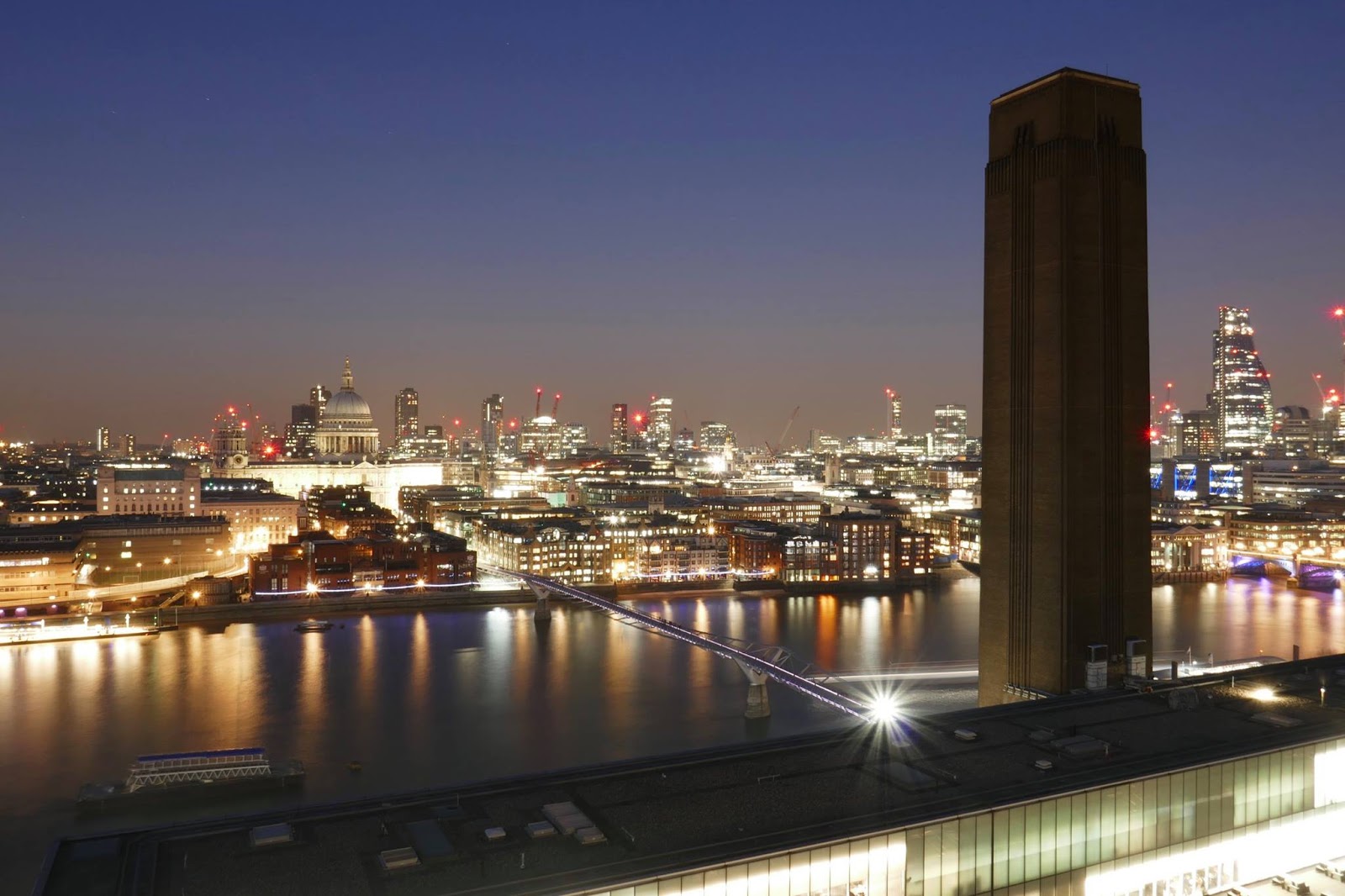
Many years ago, I watched as an abandoned power station in the middle of London was transformed into the Tate Modern, a shiny new gallery of contemporary art. For several consecutive summers towards the end of the 1990s, I was working practically next door, and year by year I could see the immense changes that were taking place both within and outside the enormous old brick building, as it transitioned from one use to another. At the time, it was the most obvious, but by no means the first, act of regeneration along the Southbank, and on this stretch of Bankside in general. The original building, constructed in two stages between 1947 and 1963, was designed by Sir Giles Gilbert Scott, famously the architect of several other British design icons, such as the red phone box and the Battersea Power Station, and its revamp was designed by Herzog & de Meuron.
There used to be enormous earth bunds between the building and the river, which in the summer served as miniature amphitheatres, in which outdoor Shakespeare performances were held. These earthworks were eventually removed, to make way for grass lawns, which inevitably could not stand up to the enormous use of the gallery visitors, quickly becoming scrubby mud patches. The Tate Modern development followed the opening of Shakespeare's Globe and, at around the same time, the Millennium Bridge across the Thames was constructed. The Tate Modern opened on 11 May 2000, the old chimney initially topped with a light-box, which changed colour.
The Millennium Bridge opened on 10 June 2000, but closed again for modifications on 12 June 2000, owing to its now infamous "wobbliness", caused by a resonant structural response. After remedial works to install motion dampers, to stop the sway caused by pedestrians, it finally reopened on 22 February 2002. To this day, some people who are unfamiliar with London, and who want to make a snide point about modern architecture, seem to like to refer to it as the "wobbly bridge", despite the fact that it has not had a significant recurrence of its initial design flaw since reopening.
Looking back, on a period of time that is now almost 20 years ago, it is hard not to feel a little nostalgic for the sense of optimism and forward thinking. I remember many happy times spent in the Founders Arms pub, a glass box on the edge of the river, which was also extended at around the same time, but all things change, and time moves on. For the Tate Modern, the most recent example of this is the "Switch House" extension, which has now opened behind the original power station building (again designed by Herzog & de Meuron), from whose viewing gallery one can have, for free, one of the best views of London.
Now, sitting in the Member's Room, on the eighth floor of the new extension, I'm feeling nostalgic, but looking out at a view of the Thames and across to the West End that would have been completely impossible twenty years ago. Despite its changes, this stretch of Bankside remains one of my favourite parts of London, even if I no longer feel that I belong to it, or it to me, quite as much as half a lifetime ago.
Tuesday, 1 November 2016
Great Gilbert Scott!
A number of years ago, when wandering along the Euston Road in London, I came across the then abandoned Victorian Gothic extravagance of the former Midland Grand Hotel, which fronted on to the St Pancras railway station. The original hotel, with its red brick spires and sweeping curved driveway up to the station, was designed by George Gilbert Scott and opened between 1873 and 1876. It ceased to be a hotel in 1935 and was used as railway offices until the 1980s, when it was shut down.
Today, it is hard to imagine a time when such a massive structure in such a prominent location could have been, effectively, abandoned, but this is what happened to the Midland Grand Hotel. In common with the nearby Kings Cross Station (which I have written about previously), the area appears to have been simply left to fall apart, and it was commonly known, when I was young, as almost a no-go area, famous more for prostitution and drugs than for its architecture, or as a desirable location in its own right.
When I walked past the building fifteen or so years ago, it was a sorry sight. Its windows were grimy and its original entrance was fenced off. Litter and dust collected on the wire fence and in its steps, whisked along by the wind-tunnel that is the Euston Road, and it was far from inviting. I was surprised, therefore, to see that a gate in the fence by the entrance was open, with a small sign inviting visitors to enter and explore. Always a fan of abandoned buildings, I looked around me, because despite the sign inviting me to do so, it still felt a little illicit, and walked in. I seem to remember a bored security guard sitting inside the front door, but other than that I was free to explore some of the ground floor rooms.
The building felt sad and unloved, with peeling paint, strip neon lighting, and damage caused by water leaks. One room, which I have since learned was originally the Coffee Lounge, had been stripped what I imagined to have been 1960s-era suspended ceiling, installed when it was an office. This had left a "tide mark" on the walls under the ceiling tiles, which had been painted more recently, and the old hotel walls above, which were of a different colour. Above it all was the original ceiling, still with grand moulded plasterwork, but punctured all over by holes from the installation of the suspended ceiling.
One of the most famous elements of the Midland Grand Hotel, even in its dilapidation, was the Grand Staircase. A striking feature of cast iron, with red and gold walls, it had been used in numerous films (such as Ian McKellan's Richard III) and music videos and, probably thanks to set dressing, was still recognisably that of a luxury hotel (even if it also had a hint of steampunk, with its mesh of industrial ironwork and faux Gothic stone).
I revisited the hotel again recently, as I was early for another appointment. It has been extensively refurbished and developed since I last visited, and it reopened in 2011 as the 5 star St. Pancras Renaissance Hotel London. The old entrance lobby (the new lobby is up the ramp, in what used to be the taxi rank) has been turned into a bar, from whose gloriously Victorian painted ceiling hang bells. As I walked back in, it was pleasant to feel life in the old building again, although I found the bar a little cramped, without feeling cosy. I usually like to sit in hotel bars and write, but I did not feel particularly inclined to do so here.
I walked past the Coffee Lounge, which is now the Gilbert Scott dining room, and registered how mightily it had been improved. Nevertheless, I felt a little sorry that this room, with its curved walls and windows looking out on the city, was not more of a public space, as I imagine it might have been originally, but at least it is being used. The Grand Staircase is as gloriously crazy as it was, but now with a deep pile carpet. Since the lobby has been moved, there feels like less of a logical connection between it and the rest of the hotel, as it was originally designed, and I did not feel inclined to sit here either, but perhaps the experience is different for those who stay and use the rest of the hotel's amenities.
I left the hotel feeling pleased that it had been salvaged from its state of ignominious abandonment, but slightly disappointed not to have felt more welcome, although perhaps that is partly a fault of the original design (in its first incarnation, after all, it only survived as a hotel for about 60 years). The architectural style is not to everybody's taste, which is one of the reasons it was been abandoned for so long, but thanks to creative thinking and massive investment, it now has another life, one that it playing its part in revitalising the wider area.
Tuesday, 2 August 2016
Ealing nostaligic
I have a minor addiction to film studios. I think that it might have begun when I was taken around Universal Studios in Hollywood, as a child, although having said that, by then I had already had bursts of obsession about Charlie Chaplin and the early days of Hollywood, so I may already have got the bug.
I'm not sure what it is that I find so fascinating; perhaps it is the sense of anticipation at what might come out of them. Possibly, it is the amazing skills of the artists who build sets, create special effects, or perform in these modern cathedral-sized spaces, or maybe even it's the last ember of a childlike fantasy that I might, if they did but know it, have something to offer the film makers inside. Whatever it is, if I am near a film studio, I cannot resist the urge to go and have a look (usually at not very much, given tight security).
Nowadays, however, I do occasionally find myself wandering around the backlots of Pinewood and Shepperton, thanks to the magic of Google Streetview. As regular readers will know, I also thoroughly enjoyed visiting the Warner Bros. Studio Tour, even if I am one of those pedantic people who knows and is still slightly bothered by the fact that the sets that you walk around are not actually in the real studios where the Harry Potter movies were filmed. Instead, just to spoil the magic slightly (although, to be fair to the Tour, they do not pretend otherwise), they are in a specially built venue next door. The "real" Leavesden Studios, where the films were actually made, is tantalisingly over the fence next to the car park.
So it was with gentle satisfaction, then, that I found myself outside Ealing Studios in West London, recently, the origin of some of my favourite old films, and one that is still, pleasingly, a site for the production of movies. The old entrance, above, is symbolic of the pocket-sized studios; on the face of it grand but, behind the white paster facade, very much make do and mend.
Ealing Studios are synonymous with a roughly six year run of glorious British films, which include such classics as Kind Hearts and Coronets (1949), Passport to Pimlico (1949), The Lavender Hill Mob (1951), The Titfield Thunderbolt (1953), and The Ladykillers (1955), although they have actually been making films on the site, in one form or another, for 114 years. I grew up watching the famous "Ealing Comedies", and others of around the same era, having been introduced to them by my late father, who was as much of a film enthusiast in his day, as I am now.
I wandered along a public alleyway, between the studios and a BT building, and I was pleased to see that the small backlot, such as it is, was filled with movie trailers. I steered guiltily clear of the security guard in his box, but sneaked a few surreptitious photos. Peering over walls and fences, I took in the pile of old props and, at the back of the studios, the rickety-looking 1930s buildings, and could imagine being transported back to the time when British cinema great such as Alec Guinness, Joan Greenwood, Peter Sellers, Dennis Price, and Alastair Sim would have been regular performers there.
Nowadays, far from being tied to its past, alongside its historic sound stages, Ealing Studios is also home to the cutting edge of cinema, in the form of Andy Serkis' studio and production company, The Imaginarium. The Imaginarium specialises in motion capture technology for film, television and video games (including for the most recent Star Wars film). Peering nosily into one of the windows on the first floor of the old entrance, I realised with a start that I must actually have been looking into Mr Serkis' office; a carved wooden gorilla perched on the windowsill being one of the clues (Andy Serkis performed, via motion capture, the title role in 2005's King Kong). Maybe, one day, I'll get to have a proper look around some studios, but for now I'm happy to indulge my addiction from afar.
Thursday, 26 May 2016
Five star gossip
I had forgotten, because I had not done it for quite a while, just how entertaining it is to sit in the lounge area of a five star hotel and to listen to the various conversations going on around you. Today, overlooking the Thames, I'm in the middle of three different American business conversations, each of which conform to different cliches of that type. To my right, a grouchy gentleman is complaining, either to the people sitting around him, or to somebody on his hand-free phone - it is hard to tell which - about a business deal of some sort, the details of which he appears angrily not to understand.
To my left, more excitingly, another American gentleman is telling numerous stories of his dealings with the Russians, a group of people he likes, but apparently treats with caution. "In the broker business..." he continues, in what, looking back over it, appears to be an almost uninterrupted monologue directed at his younger female companion, whose level of interest in his yarns it is hard to judge. I gather that his dealings with the Russians date back to the very end of the Cold War, and he confirms my suspicions, when he talks about having been advised that some of his dealings might lead to a knock at the door by men in dark coats.
I'm sitting here to take advantage of the comfortable seats, the complimentary wi-fi and the coffee which, whilst it might be fractionally more expensive than that in Starbucks, comes with all of the above, and an almost unbeatable view out over the Thames. From time to time, the riverboats pass in front of me, which suggests that it must be high tide. It feels very different, in here, from the hot day outside, and I savour my coffee and velvet sofa, on which I am making myself very much at home.
I remember when this hotel, the Mondrian London at Sea Containers, was a beautifully appointed, yet somewhat unapproachable set of offices. When it was built, it had been planned as a hotel, but the financial situation in the seventies meant that started its life as offices and had to wait over thirty years before being open to the public as originally intended. It remains, to me, one of the most New York-like hotels in London, with its "Dandelyan" bar beside the river serving a range of cocktails. Its restaurant also serves one of the best breakfasts in London, although it is worth aiming for brunch time, and allowing for enough refills from the buffet to see you through most of the rest of the day.
Labels:
bar,
cocktail,
cocktails,
coffee,
Cold War,
five star,
gossip,
hotel,
London,
Mondrian,
New York,
River Thames,
Sea Containers,
Thames,
United Kingdom
Friday, 29 April 2016
You rang, Mallard?
I paid a flying visit to Edinburgh recently, to see some friends and the band Frightened Rabbit, although by the time I returned home, I felt partly like I had been on a tour in tribute to Sir Nigel Gresley. Sir Nigel is possibly most famous for being the Chief Mechanical Engineer of the London and North Eastern Railway, and for the steam engines he designed.
Those of you who have read this blog before, something that strikes me as unlikely but remotely possible, will already be aware from my post Steam Work, that he was the designer of Mallard, the fastest steam engine in the world (which reached 126 mph (203 km/h) on 3 July 1938). Among other achievements, he had also designed the famous Flying Scotsman, which had only recently been renovated and undertaken a celebratory journey from Kings Cross to York. This train, as many will also be aware, was equally famous, being the first steam locomotive to have reached 100 miles per hour (160.9 km/h), which it did on 30 November 1934
When I arrived at Kings Cross, which I still find impressive for its successful meshing of modern and old, I discovered that only a few days before, a statue had been unveiled to Sir Nigel Gresley. I did not know it at the time, but there was a campaign running to reinstate a companion statue of a mallard duck, which had originally been planned to accompany Sir Nigel, to commemorate not only the engine of the same name, but his apparent fondness for feeding ducks at his home. I recalled Sir Nigel, from my trip to the National Rail Museum, and took a picture of the statue, thinking no more about it.
The next day, whilst admiring the fine waiting room at Edinburgh Waverley railway station, pictured above, I discovered a plaque commemorating the life and work of Sir Nigel, who had been born in Edinburgh 140 years before...
and on the train heading back down south, I noticed a large sign beside the track, commemorating the spot, at Stoke Summit on the East Coast Main Line, where in 1938 Mallard had set the world speed record for a steam locomotive. It was gone in a flash, but it felt like a sign, in every sense of the word. We can never know what impact we will leave on the world, but at that moment, it felt that Sir Nigel had definitely made his mark.
Saturday, 19 March 2016
All the world's a Globe
The London I used to know from my youthful ramblings, twenty - goodness me, is it really twenty? - years ago is, slowly but surely, giving way to a polished, sandblasted, homogenised version of its former self. For example the old Globe Inn in Borough Market (which, to be honest, I never went in twenty years ago, because it looked far too scary) has literally been sandblasted to a bright London-brick yellow, which looks both clean and yet also pretend, like a film set's painted plaster wall, masquerading as the real thing.
This is a little ironic, I suppose, as I recall coming across the filming of the first Bridget Jones film, which was being made here in 2000, and discovering that a completely fake set of railway stairs had been inserted under the arches beside the pub (in the flat above which is where Bridget Jones lived, in the film). Even then, the fake stairs had art-department painted bird droppings and graffiti to make it look authentic. At the same time I am reluctant to be unduly critical of the motivation to reclaim or repurpose otherwise near no-go areas for general use.
This area, for example, used to be grotty, smell of rotting food waste from the market, and be best walked through at a reasonably swift pace after dark. It's just that the edges have been knocked off, smoothed over, and sanitised. It seems improbable that the "characters" of old - Jeffrey Bernard, Peter O'Toole and the like - would thrive in this cleaner, gentrified, non-smoking version of London, but then perhaps their time was an anomaly - a symptom of their own post-WWII era.
I get the sense that there's a tussle going on, between the forces of regeneration and the original residents and users of the space. During the week, between 2 a.m. to 8 a.m., Borough Market is still, as its name suggests, a real wholesale market, selling fruit and vegetables, as it has done since at least 1276 (or maybe since 1014, according to the market itself, "and probably much earlier").
From Wednesday to Saturday, however, it also becomes home to stallholders, selling a wide range of food and drink from across the country and abroad (inevitably, there are a lot of "artisan" products and producers), and it is a destination in its own right for foodies and visitors after interesting tastes. Quite what the early morning vendors make of the later tenants, I don't know, but it would be interesting to see the handover between the two.
Sunday, 21 February 2016
Who nose?
There is almost always something unusual to see in London, if you are on foot, are reasonably observant, and are in the right mood. Sometimes, the things worth seeing are large and obvious, like a film shoot (which always makes me childishly excited) or a statue; other times, the things are small, like an unobtrusive sign pointing towards a "Roman Bath" (as may be seen on Surrey Street), or a brass plaque set into a wall or pavement. Regular readers may already have an idea that I enjoy spotting blue (and other coloured) plaques, commemorating the home or workplace of famous people from history.
On Admiralty Arch, between The Mall and Trafalgar Square, is a particularly small object of interest, and it's one that is often overlooked by passers by. Attached to a wall on the northernmost arch is the nose you can see above. It looks as if it is made of bronze, but I understand that it is made of plaster of Paris and polymer, and it is attached to the wall about eight feet from the ground. I cannot recall how or when I first became aware of it; I might have read something somewhere and gone looking for it, or I might have just spotted it, as a slightly incongruous protuberance on a large public building and landmark.
However I came to find it, I like that it is there. Apparently, it was placed there in 1997, along with around 34 others in various locations around the city, by artist Rick Buckley (www.rickbuckley.net) as part of a campaign against the "Big Brother" society. According to an Evening Standard article in 2011, approximately ten of Buckley's noses remain, including in front of Quo Vadis, a restaurant and private club in Soho, and somewhere outside St Pancras Station.
An odd thing about the noses, which only now occurs to me, is that - possibly because they are of such a mundane object, the human nose - one may be aware of them, but then forget about them when they are out of sight. I have a vague feeling that I have seen the St Pancras Nose which, from the photos I have seen on the web, appears to be a clay red colour, to blend in with the bricks to which it is attached, but I am not absolutely certain. There's something pleasing, however, about a work of art that retains a slightly covert character; although they are not hidden, you will only find them if you seek them out, or discover them by accident, and either way, if you do come across one, I challenge you not to raise a smile.
Saturday, 6 February 2016
Feeling a bit King's Cross
King's Cross station in London has changed a lot in recent years. For the longest time, passengers were disgorged from the underground station into a grimy, frequently rainy, forecourt under a sprawling, utilitarian, and deeply unlovely awning. Pedestrians were squeezed between a wall of dull glass-fronted kiosks and the busy Euston Road. Inside the station, passengers huddled together, in a crowded and confused space before the train tracks, hoping to catch sight of their train listing on the display boards. There were few seats to be had, and the whole experience was, on the whole, pretty dismal and depressing.
Britain's railways, dating back to their early days, contain examples of some spectacular engineering and architecture. Following the decline of (and massive underinvestment in) the railways in the 1960s, however, the nation's railways and their buildings felt for many years like a coma patient in terminal decline (pun half-intended). Stations became grimy utilitarian spaces, where they had once been glorious statements of an expanding nation's self-confidence, and it felt like there would be no reversal of the relentlessly downwards spiral.
Then something happened, in relation to Kings Cross, at any rate. Between 2005 and 2007, a £500 million restoration plan was put in place, the old mess of buildings in front of the station was done away with and, on 19 March 2012, the new - glorious - station concourse, shown above, was opened to the public. It occupies a space to the left of the old station and, with its organic-looking vaulted roof, new shops and a mezzanine floor with restaurants, it now feels as if passengers are welcome to the station rather than, as was the case before, a regrettable inconvenience.
I arrived at the station early for my train, and wandered around the new concourse, utterly entranced. It does perhaps, speak volumes for the previous standard of railway travel in Great Britain, that a decent location warrants surprise and pleasure, but be that as it may, I found myself delighted. I pottered around the large airy space, marvelling at how sensitively the new merged with the old, each enhancing the other.
The original station offices, which I cannot recall at all from the old station, have now been repurposed (or, perhaps, returned to their original, logical, purpose) as ticket offices and shops, and the original yellow London brick buildings feel, if it is not too fanciful, to have a restored sense of pride. I was pleased, but not entirely surprised, to discover that in 2013 the restoration project had been awarded a European Union Prize for Cultural Heritage / Europa Nostra Award.
King's Cross is known to millions of Harry Potter fans across the world as the location of Platform 9 3/4, and the Harry Potter Store to one side feels appropriate, as does the luggage trolley disappearing into the brick wall. When I was there, a long queue of fans was waiting to have their photo taken, Hogwarts scarves flying, pretending to be about to join the Hogwarts Express. Elsewhere to my childish delight, a falconer was flying his hawk around the space to deter pigeons, and the station felt - as I like to imagine it might have felt when it was first built - like a vibrant and exciting place to start a journey.
Wednesday, 20 January 2016
Hodge your bets
In Gough Square in the City of London stands the above statue to Hodge, Dr Johnson's cat (whose ears, I can't help but feel, are actually just a little too big). I first met this Hodge around Christmas time, one year, when he had a collar of tinsel, and a pleasingly festive air. He stands, on a plinth, outside Dr Johnson's house, on which is written "HODGE a very fine cat indeed belonging to SAMUEL JOHNSON", repeating a quotation attributed to him in in James Boswell's Life of Johnson. Dr Johnson is supposed to have said of his pet "He is a very fine cat, a very fine cat indeed."
There is something deeply humanising about hearing about how famous historical figures interacted with their animals, and indeed the names they gave to them. Hodge is a great name for a cat, but I think that I slightly prefer the name given by Edward Lear to his tubby tabby cat - Foss. I have also always liked the story about Hodge, again told by Boswell, that Dr Johnson would go out himself to buy oysters for his cat, rather then make is servants do it, so that they wouldn't dislike Hodge for having been put to extra work.
Labels:
Cat,
cats,
City of London,
Dr Johnson,
England,
Gough Square,
Hodge,
London,
oysters,
Samuel Johnson,
UK
Thursday, 14 January 2016
Jurassic Parklife
Sometime in 1852, sculptor and natural history artist Benjamin Waterhouse Hawkins was commissioned to create 33 "life-size" models of extinct animals (including, most famously, dinosaurs) out of concrete, to be displayed to the public. The fact that the very idea of dinosaurs was relatively new (the name "Dinosauria was only given to these creatures by Sir Richard Owen in 1842) and not altogether well-understood (Darwin's "On the Origin of Species" was not published until 1859) does not appear to have dissuaded Hawkins unduly. Over the following three years, accordingly, and in collaboration with Owen and other paleontologists, Hawkins set about creating the arrestingly odd collection of figures that are still on display in the grounds of Crystal Palace in South London today.
I had heard about these unlikely beasts years before, but only recently had determined to actually make the effort required to visit them and was still unsure what to expect. The Crystal Palace site is, itself, a remarkable remnant of times past. Although it was the second location of the enormous glass exhibition hall, first erected in Hyde Park for the Great Exhibition of 1851, just about all that remains of it is the footprint of the giant building. Below this are the surviving steps leading down to wide terraces, whose glory days of supreme manicuring are, presumably, long gone.
The building itself burned to the ground in 1936, having been moved from Hyde Park (and greatly expanded in the process) in 1854. Wandering about the ruins today, and seeing tantalising hints of what might have been, tucked away behind wire fences and beneath the undergrowth, here and there, it is hard to escape the feeling that the world that the Victorians experienced, for all that it had undoubted and extreme deprivations for many, was also almost unbelievably breathtaking; an age of supreme ambition. Even before its move and inflation, the original Crystal Palace in Hyde Park was 1,851 feet (564 m) long, 128 feet (39 m) tall and with 990,000 square feet (92,000 m2) of floor space, and in its new location its scale only increased.
Today, several levels below where the Crystal Palace once stood, despite years of ridicule for their appearance, once dinosaurs became better understood (and their 1850s appearance having been dismissed as inaccurate), having been ignored, overgrown, rediscovered and restored (more than once), the dinosaurs still reside beside their pools of water. They were most recently restored in 2002 and are now Grade I listed buildings (pleasingly, the same classification as Buckingham Palace and the Palace of Westminster). They are, without question, an odd day out. In fact, and with all due respect to them, they probably do not merit a complete day in themselves (if you're interested, it's also worth checking out the Park Farm, nearby, as well as the ruins of Crystal Palace) but they are certainly worth a visit.
They are broadly laid out in different geological eras, and include figures of prehistoric mammals, but it is the dinosaurs, including the iguanodons, pictured above, that are the real draw. Don't go expecting a real life Jurassic Park experience; these beasts are static and don't really accord with our current understanding of what dinosaurs looked like. Thinking abut it, however, we really shouldn't be too smug about what we consider to be "knowledge"; in my lifetime alone, for example, dinosaurs have gone from being widely believed to be big green scaly monsters, to brightly coloured feathered creatures,. Any assumption that our current era really "knows" anything should, within certain parameters, be treated with great suspicion.
Tuesday, 5 January 2016
Tales from the American Bar
The American Bar of the Savoy Hotel, London is an art deco masterpiece, and the origin of a number of world-famous cocktails. Dotted around its curving walls are pictures of stars of yesteryear who once frequented it - among them, Clark Gable, Errol Flynn, Fred Astaire, and Marlene Dietrich - and with a live pianist cranking out and singing the classics, it's a place worth visiting for a drink or two.
Last year, I went on my birthday, partly in search of a cocktail to match one I had enjoyed in New York earlier in the year. On our last night in New York, we had gone to the bar at Perry St., where an amazing mixologist called Mac listened to our moods and preferences, and went away to do strange and unusual things with alcohol and mixers.
When he returned a little later, he watched as a waiter dished out our various drinks, and before we were allowed to taste them, he have us their history (some were pre-prohibition, he explained). My cocktail was to be an Aviation, but he told me to wait before sampling it, as he poured a violet-coloured liquid down a glass mixing stick. I gather that the Aviation is made with gin, maraschino liqueur, crème de violette, and lemon juice, but this simple list is, I suspect, only the half of the mixer's skill.
It was, without question, the single best cocktail I had ever had, and on a few occasions since, I have tried, and failed, to get somebody to replicate it. My New York Aviation, pictured above, had a floating "cloud-base", and a flavour of a delicate complexity that I have not experienced before or since. All mightily impressed, we asked Mac where he had learned his almost alchemical craft. "I trained," he said, "under a full-blooded Cherokee named Ed," and we nodded sagely at this semi-mystical statement.
Back at the Savoy, more recently, I ordered another Aviation, expecting a two layered drink of wonder, but instead I received a disappointingly ordinary-looking glass containing a drink of one colour and a maraschino cherry. I have learned, subsequently, that some mixers omit the crème de violette, and it may be that this is the missing magic, or maybe there was something in the teachings of Ed, passed down to Mac, that are simply not replicable by ordinary mortals.
Labels:
cocktail,
London,
mixing,
mixologist,
New York,
NYC,
Perry,
Perry St,
Perry Street,
Savoy,
United Kingdom,
United States,
USA
Thursday, 29 October 2015
The Doctor will see you now
Over a year ago, a strange place by Paddington Station in London closed its doors to the public for the last time. Within the red-brick walls of a former Royal Mail sorting office had been the world of Temple Studios, part of The Drowned Man, a massive immersive theatre production by Punchdrunk, in association with the National Theatre. Over four floors of this building were intricately detailed sets, through which a cast, pursued by audience members wearing white masks, danced, ran and fought. I loved it.
For some audience members, the experience became an obsession and, whilst I went a few times, it never became completely overwhelming for me. The modern dance, whilst impressive in its way, was not particularly interesting for me. No, for me, it was the chance to wander around what felt like genuine films sets; to, as the recurring line from the lay ran, live within a dream.
On my first visit, I had watched occasional audience members be singled out by performers, and be taken into private rooms for what became known, within the audience members social network, as "one to ones". On subsequent visits, I had experienced some of my own - with the greengrocer, the strange owner of the toyshop, the seamstress, but on the final occasion I visited, I hoped to have a one to one with the doctor, whom I had also seen early on my first trip.
That final night, with two or three other audience members, I had watched the doctor make a Rorschach test in his office, dripping ink into a folded piece of paper, unfolding it and considering the resulting pattern. Again, with others I followed him outside, and then watched as he took another white masked audience member into the private consultation room. Pah! I thought, and wandered off to see something else in the labyrinthine set.
Later, I wandered back through the doctor's main examination room, and saw the doctor again. This time, I must have been in the right place at the right time. He sauntered out of his office and I happened to be in front of him outside the consultation room. He fished in his pocket for his keys, and with hooded lids looked up at me.
"All right," he said, almost grudgingly. "I'll see you now. Come in."
He opened the door into the consulting room and we went inside. He locked the door behind us, took off the mask I was wearing and gestured for me to sit on the consulting table.
"How have you been?" he asked. "Have you been having any more of those bad feelings we talked about? No dark thoughts?"
"No," I said, trying to keep in character. He nodded and looked me up and down, as if assessing how I was doing.
"I'm going to show you some pictures," he said, reaching for a box on the side, "and I want you to tell me what you see. Ok?"
"Sure," I replied.
He nodded some more and held out one Rorschach picture for me to examine. "What do you see?"
I thought for a bit, and then said, "A skull." He mulled this over and then put the picture away, bringing out another.
"How about this one?"
Part of me wanted to say something silly, but there was something profoundly hypnotic about the situation, so I looked at it again. He asked again, "What do you see?"
"A hanged man." I said, despite myself. He reflected on this for a moment, and looked at me. "'A hanged man', huh?"
"Yeah," I replied.
He thought for a bit longer, and tilted his head form side to side, as if judging the weight of what I had said. Then he looked at me, still thoughtful. "Hang-dang," he half sang, slightly mocking. "Hang-dang... ding-dang."
He was staring at me quite intently, and I was strongly conscious of a desire to smile or laugh, in spite of the strangeness of the moment; the same sort of crazy impulse that makes people laugh at funerals - it's the worst possible thing one could do, which is why it becomes almost the only thing one wants to do.
He put the pictures away and sat next to me on the consulting table. He looked at me, keeping eye contact, then he looked away.
"Nobody likes you," he said, half matter of factly, half aggressively. "People avoid you." Then he nodded, as if that part of the consultation was over, and told me to face the wall, on which was an eye chart. He told me to read it, and I did, line my line.
Half way through, he clamped one hand over my eyes, and the other around the back of my head. All the time, music was swelling around us, and he talked directly into my ear, as he massaged my head.
"You like people," he said. "People like you. You are friendly. You are tidy. When you see a piece of paper on the floor you pick it up."
Then the music reached a crescendo, and it was over. He put my mask back on and led me towards the door, pausing slightly. I looked down where we were standing, and saw a piece of paper on the floor. I bent down to pick it up, I pocketed it, without looking at it, and left the consulting room, as he opened the door.
When I had crossed the boardroom beyond his corridor, I un-crumpled the paper, and written on it were the words, "You're making good progress."
Sunday, 25 October 2015
A massage in a bottle
Some massages, it has been well said, are akin being stroked in a dark room. Perhaps some people like such a gentle experience; I do not. In contrast, the massage I had yesterday was much more like to being beaten up in a dark room, albeit to the accompaniment of generic ambient music and distant forest birdsong. The background sounds aside, this was much more the thing, although I did find myself wincing, holding my breath, and properly bracing myself, as my otherwise charming and softly spoken masseuse dug the sharpest point of her elbow deeper into the tangibly tense tangle of stressy knots in the muscles around my scapulae.
"Soft to medium," she had said, when running through the pre-massage checks, and I have to confess that my heart had sunk, as I anticipated another low-powered kneading. Nevertheless, after a stressful week, just about any massage is better than no massage, and I surrendered myself to her ministrations. After the usual anointment with oils and brief feet rub, I breathed in deeply and resolved, in any event, to enjoy the peaceful darkness. And then it began, with a vigour that drove just about all other thoughts from my mind save for the question of whether I would survive this encounter, or if I should ask for her to go slightly more gently.
As I surrendered to the experience, with the possibly naive, but certainly trusting thought that she presumably knew what she was doing, I recalled a previous massage which approached this level of intensity. It had been a few months back, in NoLita in New York. Having pounded the streets for several days, my back and neck had started sending out distress calls and, as I sat in a bar on Lafayette, doing something about the pain became a pressing concern.
The barman suggested a Chinese massage parlour next door and, beggars not being choosers, I stepped down into the subterranean world, hopeful of repair. Unlike any massage parlours I had visited before, this was one large darkened room, divided up by perhaps five feet high panels into six or eight booths. In each booth was a bed and, as I did as I was directed and walked down to the end booth, I realised that each one was occupied by a patron, at least one of whom was snoring.
In my booth, which I shared with drums of cooking oil, presumably for the Chinese restaurant above, I was told to get undressed. A little wary, I removed my shirt and, when barked at by my masseuse for my foolish error, my jeans also. Lying on the bed, reading the labels on the cooking oil canisters, to one side, I wondered what was to come, when I became aware that not alone. I was barked at again, in what I presumed was an enquiry as to what I wanted. I wasn't entirely sure what she had asked me, but I made rough gestures towards my neck, and the treatment began.
It is said that we cannot accurately recall our pain, when looking back, and this is, perhaps, an extremely good thing. What I do recall is that I emerged, blinking, from the basement room into the sunshine, conscious of having been pummelled mercilessly, but nevertheless feeling brighter and more awake. So yesterday, as my London masseuse piled down onto my back and asked "Is that OK?" I winced again, before painfully breathing out a laboured and not entirely truthful, "Fine. Thanks," hopeful that the outcome might be equally rewarding.
Thursday, 17 September 2015
A plaque on both your houses
In these frantic times, it's good to take a minute now and then to remember some of our sadly lesser-known, yet nevertheless important, figures from history.
In my regular wanderings, I am frequently surprised by how little attention the average pedestrian (far less the average driver or gyrocopter pilot) pays to the plaques and memorials that dot or, if you prefer, pepper our streets. Sometimes these panels record interesting, successful or famous people; sometimes the locations of discoveries or events of great historical importance.
If only we looked up a little more, it sometimes seems to me, our lives could be enriched and enlivened by the thought of those who came before us (even if those thoughts should probably not, in all good conscience, always be considered to be entirely historically accurate).
This week, it's time to celebrate Dr James Yearsley, founder of the Metropolitan Ear Institute in London in 1838. Dr Yearsley is rightly recognised with this green plaque at 32 Sackville Street, Piccadilly, London, the site of his former clinic.
Without Dr Yearsley's tireless work and years of painstaking research, the chances are we still wouldn't have ears today or, as they were originally known in honour of their inventor, "Yearsleys". Queen Victoria who, for all any of us know, may have been a regular visitor to the clinic, is reported in Court circles to have been seen "grinning from Yearsley to Yearsley" after a successful appointment with the good doctor.
Labels:
Dr James Yearsley,
ear,
ears,
England,
Institute,
London,
Metropolitan,
Piccadilly,
plaque,
UK,
United Kingdom
Subscribe to:
Posts (Atom)