Showing posts with label Gilbert Scott. Show all posts

Friday, 28 April 2017

Concen-Tate


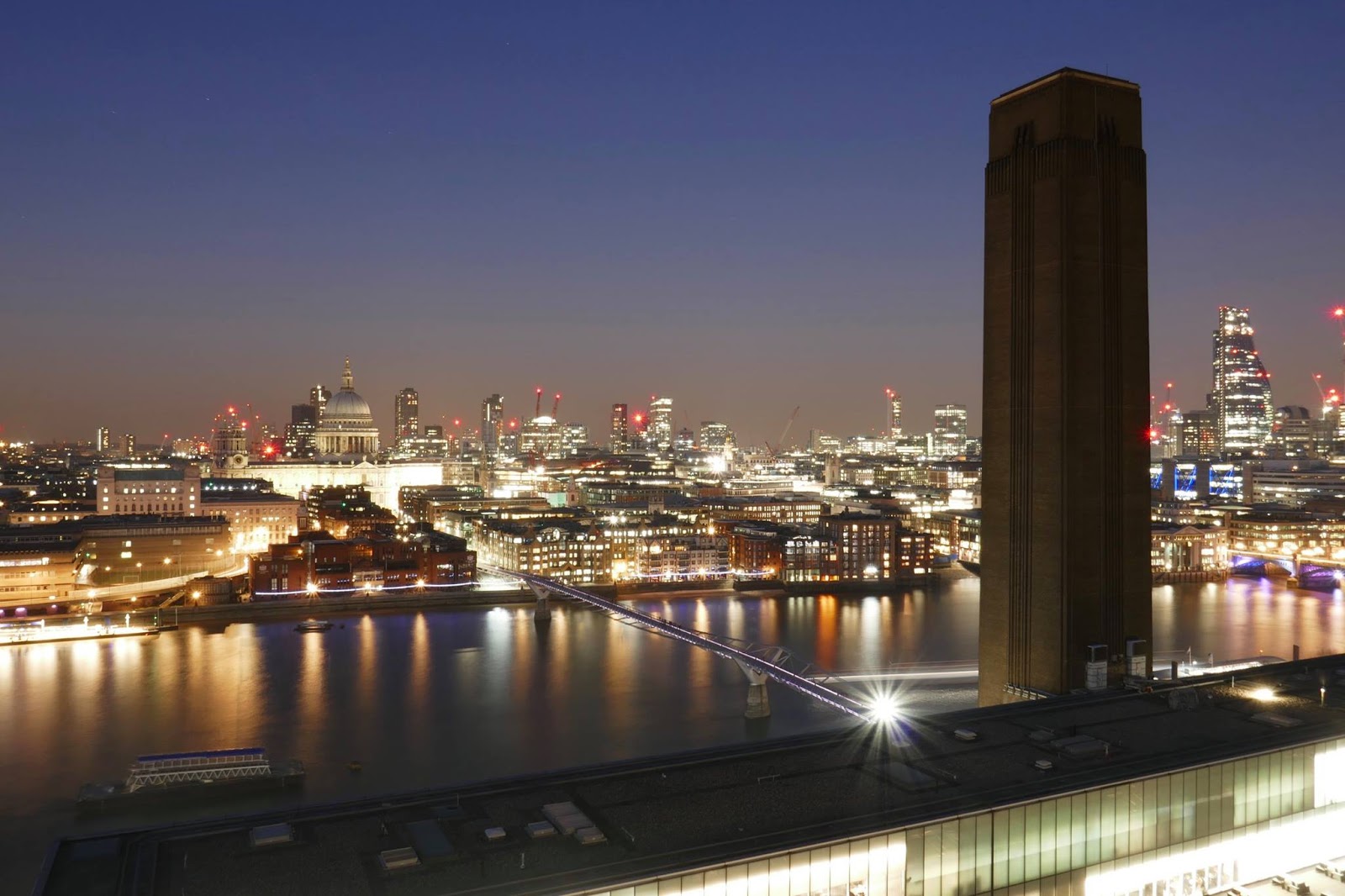
Many years ago, I watched as an abandoned power station in the middle of London was transformed into the Tate Modern, a shiny new gallery of contemporary art. For several consecutive summers towards the end of the 1990s, I was working practically next door, and year by year I could see the immense changes that were taking place both within and outside the enormous old brick building, as it transitioned from one use to another. At the time, it was the most obvious, but by no means the first, act of regeneration along the Southbank, and on this stretch of Bankside in general. The original building, constructed in two stages between 1947 and 1963, was designed by Sir Giles Gilbert Scott, famously the architect of several other British design icons, such as the red phone box and the Battersea Power Station, and its revamp was designed by Herzog & de Meuron.

There used to be enormous earth bunds between the building and the river, which in the summer served as miniature amphitheatres, in which outdoor Shakespeare performances were held. These earthworks were eventually removed, to make way for grass lawns, which inevitably could not stand up to the enormous use of the gallery visitors, quickly becoming scrubby mud patches. The Tate Modern development followed the opening of Shakespeare's Globe and, at around the same time, the Millennium Bridge across the Thames was constructed. The Tate Modern opened on 11 May 2000, the old chimney initially topped with a light-box, which changed colour.

The Millennium  Bridge opened on 10 June 2000, but closed again for modifications on 12 June 2000, owing to its now infamous "wobbliness", caused by a resonant structural response. After remedial works to install motion dampers, to stop the sway caused by pedestrians, it finally reopened on 22 February 2002. To this day, some people who are unfamiliar with London, and who want to make a snide point about modern architecture, seem to like to refer to it as the "wobbly bridge", despite the fact that it has not had a significant recurrence of its initial design flaw since reopening.

Looking back, on a period of time that is now almost 20 years ago, it is hard not to feel a little nostalgic for the sense of optimism and forward thinking. I remember many happy times spent in the Founders Arms pub, a glass box on the edge of the river, which was also extended at around the same time, but all things change, and time moves on. For the Tate Modern, the most recent example of this is the "Switch House" extension, which has now opened behind the original power station building (again designed by Herzog & de Meuron), from whose viewing gallery one can have, for free, one of the best views of London.

Now, sitting in the Member's Room, on the eighth floor of the new extension, I'm feeling nostalgic, but looking out at a view of the Thames and across to the West End that would have been completely impossible twenty years ago. Despite its changes, this stretch of Bankside remains one of my favourite parts of London, even if I no longer feel that I belong to it, or it to me, quite as much as half a lifetime ago.

Tuesday, 1 November 2016

Great Gilbert Scott!


A number of years ago, when wandering along the Euston Road in London, I came across the then abandoned Victorian Gothic extravagance of the former Midland Grand Hotel, which fronted on to the St Pancras railway station. The original hotel, with its red brick spires and sweeping curved driveway up to the station, was designed by George Gilbert Scott and opened between 1873 and 1876. It ceased to be a hotel in 1935 and was used as railway offices until the 1980s, when it was shut down.

Today, it is hard to imagine a time when such a massive structure in such a prominent location could have been, effectively, abandoned, but this is what happened to the Midland Grand Hotel. In common with the nearby Kings Cross Station (which I have written about previously), the area appears to have been simply left to fall apart, and it was commonly known, when I was young, as almost a no-go area, famous more for prostitution and drugs than for its architecture, or as a desirable location in its own right.

When I walked past the building fifteen or so years ago, it was a sorry sight. Its windows were grimy and its original entrance was fenced off. Litter and dust collected on the wire fence and in its steps, whisked along by the wind-tunnel that is the Euston Road, and it was far from inviting. I was surprised, therefore, to see that a gate in the fence by the entrance was open, with a small sign inviting visitors to enter and explore. Always a fan of abandoned buildings, I looked around me, because despite the sign inviting me to do so, it still felt a little illicit, and walked in. I seem to remember a bored security guard sitting inside the front door, but other than that I was free to explore some of the ground floor rooms.

The building felt sad and unloved, with peeling paint, strip neon lighting, and damage caused by water leaks. One room, which I have since learned was originally the Coffee Lounge, had been stripped what I imagined to have been 1960s-era suspended ceiling, installed when it was an office. This had left a "tide mark" on the walls under the ceiling tiles, which had been painted more recently, and the old hotel walls above, which were of a different colour. Above it all was the original ceiling, still with grand moulded plasterwork, but punctured all over by holes from the installation of the suspended ceiling.

One of the most famous elements of the Midland Grand Hotel, even in its dilapidation, was the Grand Staircase. A striking feature of cast iron, with red and gold walls, it had been used in numerous films (such as Ian McKellan's Richard III) and music videos and, probably thanks to set dressing, was still recognisably that of a luxury hotel (even if it also had a hint of steampunk, with its mesh of industrial ironwork and faux Gothic stone).

I revisited the hotel again recently, as I was early for another appointment. It has been extensively refurbished and developed since I last visited, and it reopened in 2011 as the 5 star St. Pancras Renaissance Hotel London. The old entrance lobby (the new lobby is up the ramp, in what used to be the taxi rank) has been turned into a bar, from whose gloriously Victorian painted ceiling hang bells. As I walked back in, it was pleasant to feel life in the old building again, although I found the bar a little cramped, without feeling cosy. I usually like to sit in hotel bars and write, but I did not feel particularly inclined to do so here.

I walked past the Coffee Lounge, which is now the Gilbert Scott dining room, and registered how mightily it had been improved. Nevertheless, I felt a little sorry that this room, with its curved walls and windows looking out on the city, was not more of a public space, as I imagine it might have been originally, but at least it is being used. The Grand Staircase is as gloriously crazy as it was, but now with a deep pile carpet. Since the lobby has been moved, there feels like less of a logical connection between it and the rest of the hotel, as it was originally designed, and I did not feel inclined to sit here either, but perhaps the experience is different for those who stay and use the rest of the hotel's amenities.

I left the hotel feeling pleased that it had been salvaged from its state of ignominious abandonment, but slightly disappointed not to have felt more welcome, although perhaps that is partly a fault of the original design (in its first incarnation, after all, it only survived as a hotel for about 60 years). The architectural style is not to everybody's taste, which is one of the reasons it was been abandoned for so long, but thanks to creative thinking and massive investment, it now has another life, one that it playing its part in revitalising the wider area.